The First Three Slides That Decide Everything: How Investors Really Evaluate Pitch Decks
The first three slides of your pitch deck determine everything. Here's exactly what investors look for in Problem, Solution, and Market - and why slide 4 is the breaking point.

You spent eighteen hours on that deck.
You rewrote the problem slide four times. You rebuilt the market sizing from scratch. You debated the team slide for two days. You hit send on a Tuesday morning.
The investor opened it on Wednesday afternoon and spent under two minutes on it.
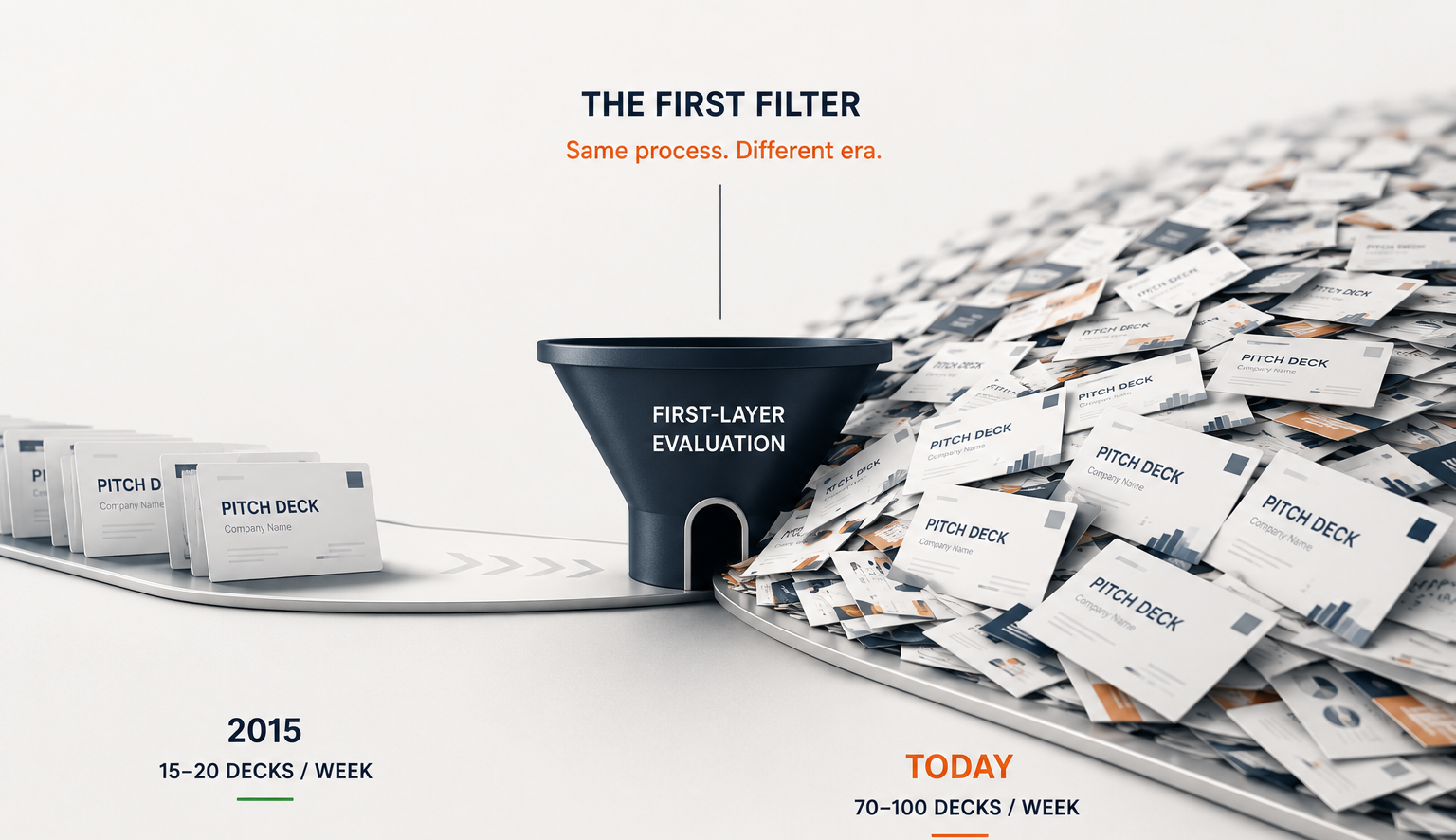
Not because they are careless. Because they receive hundreds of decks and the ones that do not grab attention in the first three slides do not earn the next three. That deck you spent eighteen hours on had under two minutes to make its case.
This is not a reason to despair. It is a reason to understand exactly how investors evaluate pitch decks in those critical opening moments - what they look for, in what order, and what causes them to stop reading versus keep going. Whether you're a first-time founder seeking startup pitch tips or a seasoned entrepreneur refining your investor meeting preparation, this breakdown is your foundation.
The First Three Slides Decide Everything
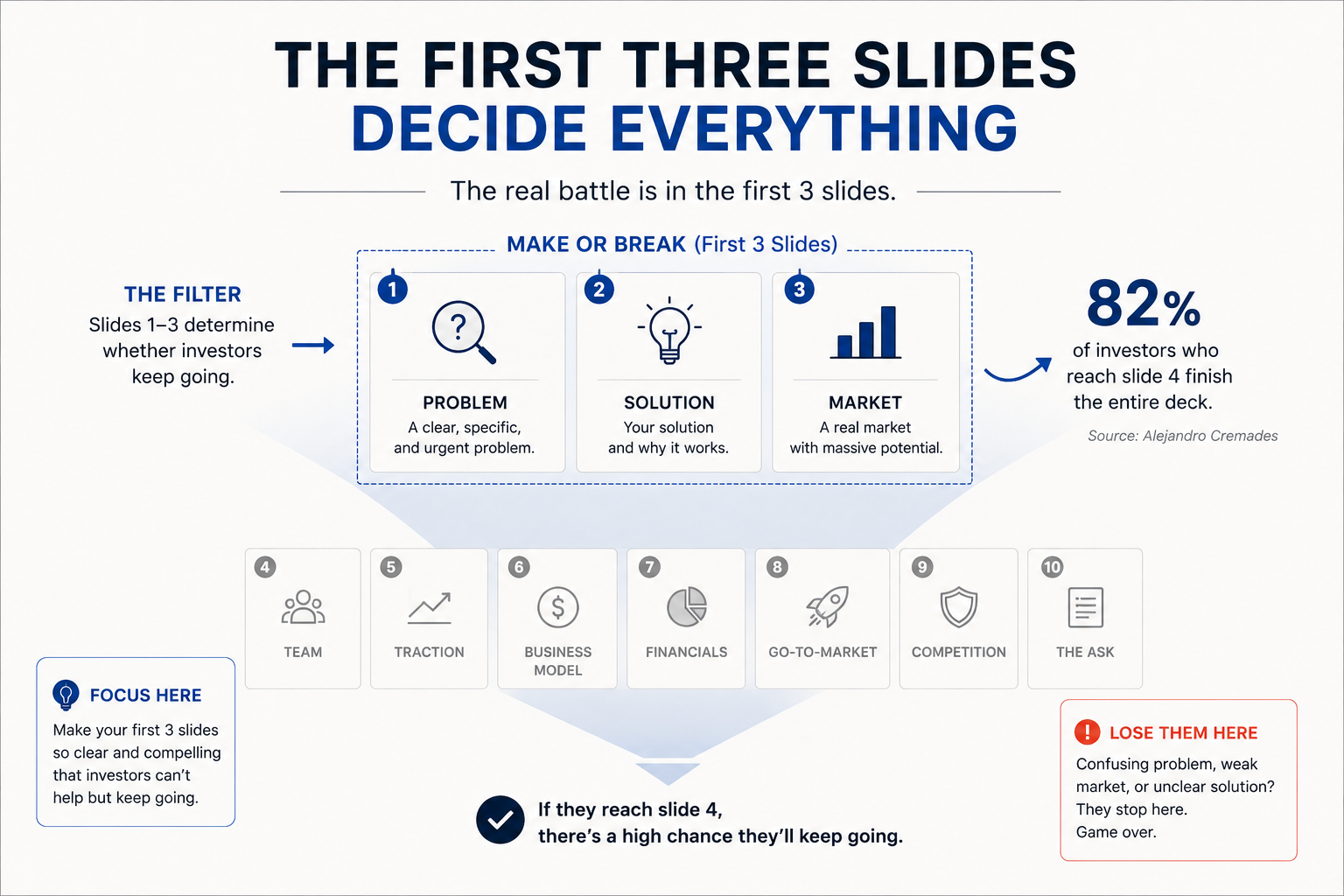
"82% of investors who reach slide 4 finish the entire presentation. The real battle is in those first three slides."
Read that again. If an investor gets to your fourth slide, there is an 82% chance they finish the whole thing. The entire game is getting to slide 4.
What lives in those first three slides? Problem. Solution. Market. These are not introductory slides. They are the filter. They are the moment an investor decides whether the next twelve minutes of their life are worth spending on your company.
If your problem slide takes more than twenty seconds to understand, it is not clear enough. If your market slide shows a $50 billion TAM without explaining how you capture any of it, it will not land.
Do not ease into your pitch. Start with the problem - sharp, specific, undeniable. Then solve it. Then show the market. Everything else is supporting evidence.
The Team Slide Gets More Attention Than You Think

The team slide gets the most investor attention. This surprises most founders, who assume investors focus primarily on the market or the product.
Investors are not just evaluating your business - they are evaluating you. They are asking one question above everything else: does this team have an unfair advantage in solving this specific problem?
Your team slide should not be a list of job titles and university names. It should answer the "why us" question with specificity. Not "we have 10 years of combined experience in fintech." But "Arun spent 7 years building credit infrastructure at HDFC Bank and saw this exact problem from the inside. Priya built and sold a logistics platform in Southeast Asia before this. Neither of us is guessing."
Domain expertise that is directly relevant to the problem you are solving is the most powerful signal on the team slide. This is what separates founders who are qualified to win from founders who simply had an idea.
When investors look at your team slide, they are running a quick but brutal assessment: Can these specific people win this specific market? Have they proven they can build, sell, or understand this domain? Or are they founders-of-opportunity who fit the trend of the moment?
The difference shows up in how you frame experience. Generic credentials are forgettable. Specific, relevant domain experience is unforgettable.
The Three Slides That Matter: What Each One Must Do
Slide 1: The Problem Slide
This is your hook. You have twenty seconds.
The problem slide does one thing: it makes the investor nod and think, "Yes, I have seen this problem." It does not introduce your company. It does not mention your solution. It identifies a problem so clear and urgent that the investor recognizes it immediately.
A strong problem slide is specific. Not "businesses waste time on data entry." But "sales teams at mid-market SaaS companies spend 14 hours per week on manual data entry, creating friction in deal close and eroding forecast accuracy."
The specificity does two things. First, it signals that you have actually talked to customers and understand their pain. Second, it allows the investor to picture the exact customer and situation, which makes the problem feel real instead of theoretical.
The problem also needs to be urgent. Venture investors do not fund nice-to-haves. They fund problems so painful that companies will pay to solve them, and founders will move heaven and earth to solve them. If your problem can wait, it is not a venture problem.
Slide 2: The Solution Slide
Now you solve it.
Your solution slide should make the logical connection between the problem and your solution so obvious that an investor does not have to work to understand it. The investor should not think, "Okay, I see the problem, but how does this fix it?" If they have to ask that question, the connection is not clear enough.
Show how your solution specifically addresses the pain points you outlined in the problem slide. If the problem is "14 hours per week on manual data entry," the solution is not "we built a software platform." It is "we built an API that syncs data directly from email and calendar into your CRM, eliminating manual entry entirely."
This is where you introduce your company and your approach. But keep it focused. Do not try to show everything you can do. Show only what solves the problem.
Slide 3: The Market Slide
This is where most founders stumble.
The market slide shows why this problem matters at scale. But most founders mess this up by leading with a massive TAM number - "Our market is $50 billion" - without explaining how they will ever capture a meaningful slice of it.
Drop the $50B TAM bubble chart. Instead, show your SOM - the precise slice of the market you can actually win in the next 18 months - with a clear go-to-market rationale underneath it.
The investor is not asking how big the market is. They are asking, "Can I see how this becomes a real business?" A founder who can articulate a $10 million addressable market with a clear path to capture it is more fundable than a founder waving a $50 billion TAM with no customer acquisition strategy.
The market slide should answer: Who is my first customer? How do I reach them? Why will they buy? How much will they pay? If you can answer those questions clearly, the market slide becomes credible.
The Warm Introduction Advantage - And What to Do Without One
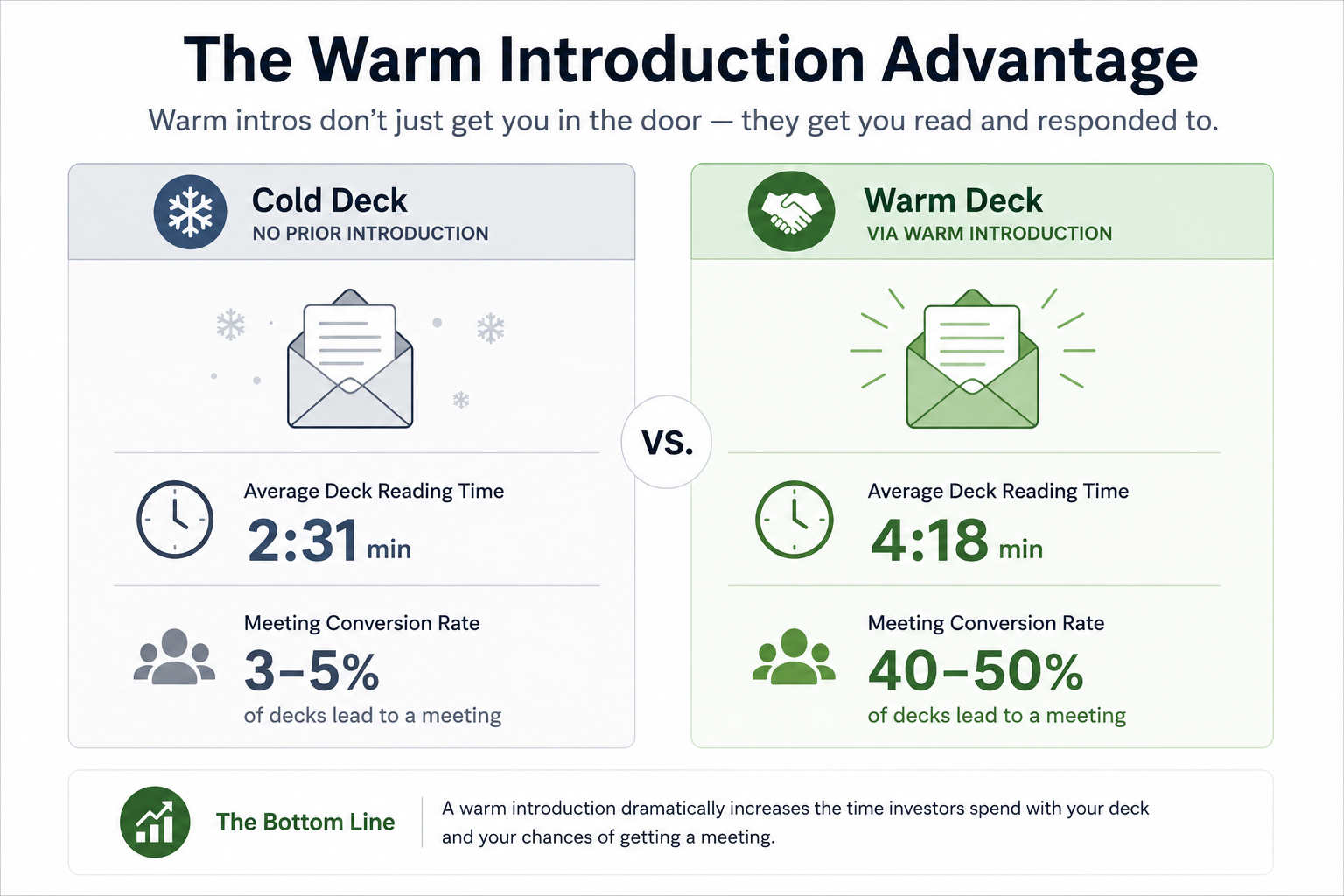
Cold decks average reading time of 2 minutes 31 seconds with approximately 3-5% converting to a meeting request. Warm decks average reading time of 4 minutes 18 seconds with approximately 40-50% converting to a meeting request.
The difference is not subtle. A warm introduction roughly doubles the time an investor spends on your deck and increases meeting conversion by ten to fifteen times.
If you have warm introductions available, use them. Every one of them. But most founders - especially first-time founders, founders from non-traditional networks, founders building in markets outside major startup hubs - do not have extensive warm introduction networks.
For those founders, the deck has to work harder. The first slide has to be so clear and compelling that it earns the next. The problem statement has to be so specific and validated that it creates credibility without a personal endorsement. The traction data has to be real and specific enough to substitute for the trust that a warm introduction provides.
This is a harder path. But it is a navigable one. And it starts with understanding exactly how the evaluation works - which you are building now. And if you want to practice your pitch before facing a real investor, you have options beyond expensive coaching.
Before You Send This First Version
Run your first three slides through this checklist:
- Problem slide: Can you communicate your problem in under twenty seconds? Does it feel urgent and real, not theoretical?
- Solution slide: Without any additional explanation, is it immediately clear how your solution solves the problem you identified?
- Market slide: Have you shown your Serviceable Obtainable Market (SOM) for the next 18 months, not just a massive TAM number?
- Team slide: Does your team slide explain specifically why these people win this market - not just their titles and credentials?
- Clarity: Could an investor follow the logic from problem to solution to market without getting confused?
If any of those answers is no, you know what to fix before the investor ever sees it.
The investors who become your partners are not looking for perfection. They are looking for clarity and conviction. A founder who understands how they are being evaluated - and has prepared the first three slides accordingly - signals competence before they say a word.
You don't need a pitch coach to find these gaps before they cost you. Startup Pitch Analyser runs a live AI investor evaluation on your specific deck, asks the hard follow-up questions real investors ask, and delivers a structured Evaluation Report showing exactly what's working and what needs to be fixed — before you're in a real meeting.