What Investors Actually Ask in a Pitch Meeting (And How to Walk In Ready)
Most founders prepare the deck. Few prepare for the questions after it. Here's what investors actually ask and why the follow-up is where most pitches fall apart.

Most founders prepare for the wrong moment.
They spend weeks getting the deck right, tightening the narrative, picking the right chart for traction, wrestling with how many slides is too many. And then they walk into the room ready to present. But the part of the meeting that actually decides the outcome usually isn't the part anyone rehearsed. It's five minutes after the slides stop.
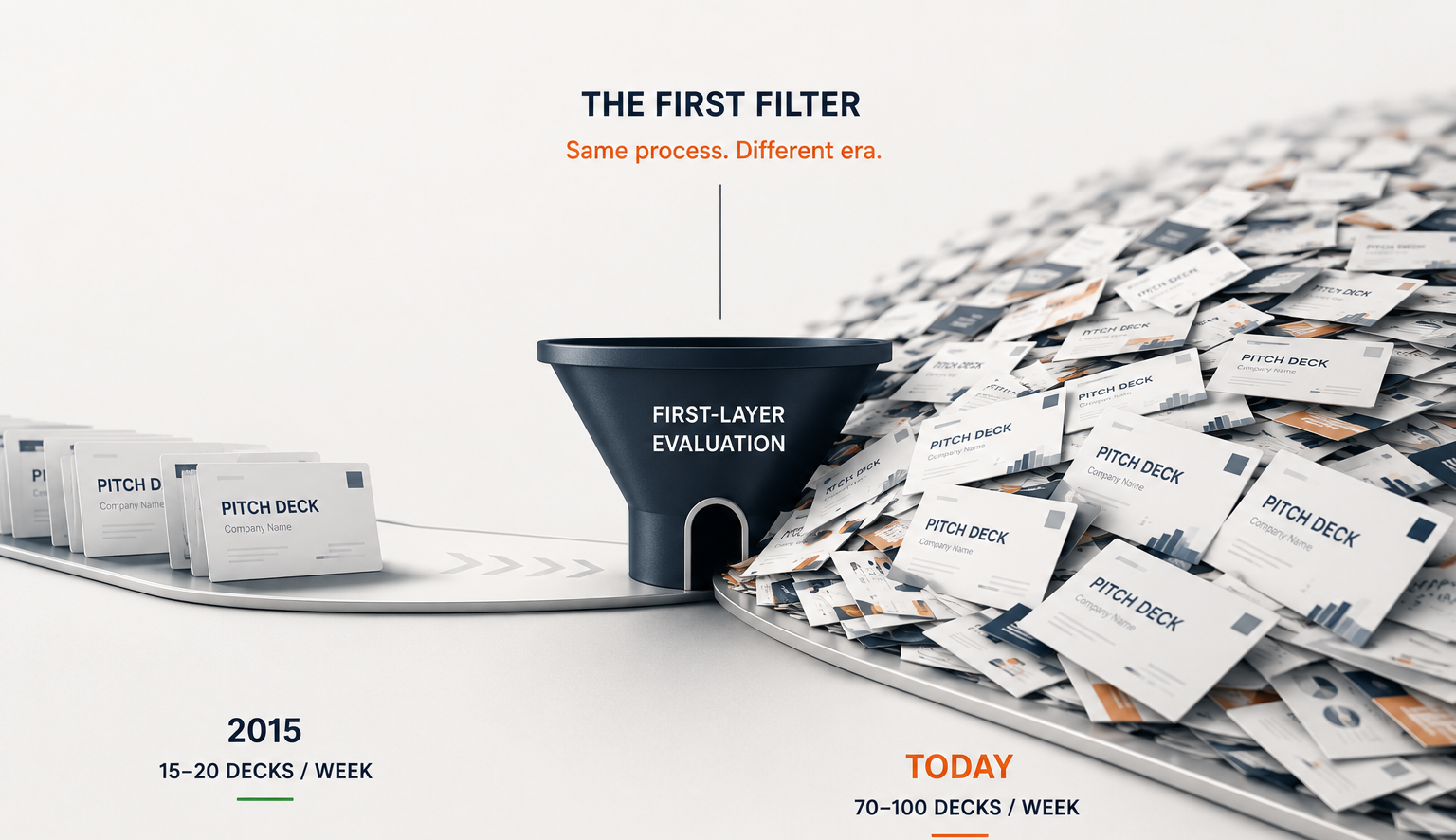
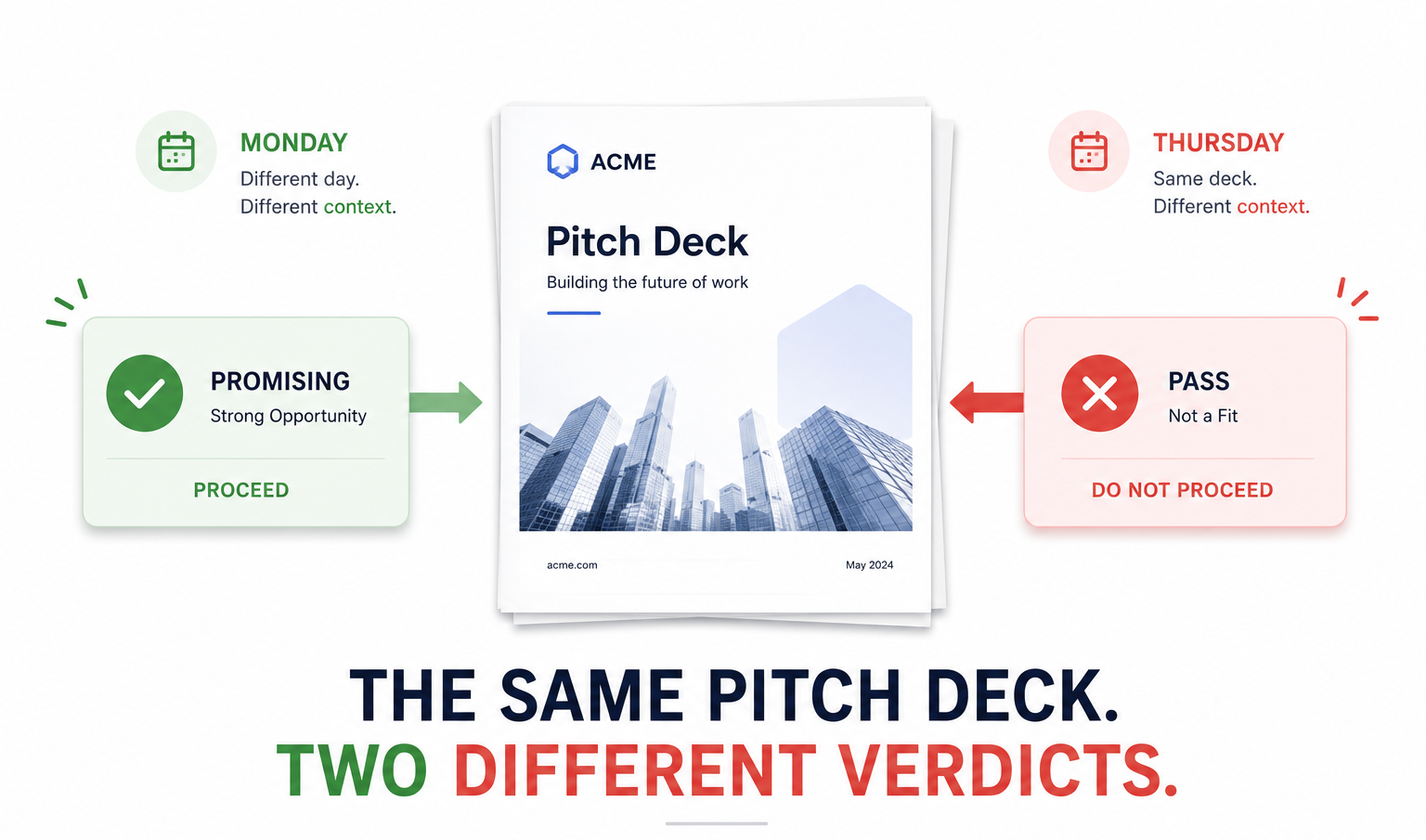
Investors don't read pitch decks the way founders imagine. Research by DocSend, tracking hundreds of actual fundraising decks, found that VCs spend just a few minutes on a deck before deciding whether a meeting is worth having at all — and that first read shapes everything that follows in the live conversation. By the time you're in the room, the investor has already formed an early opinion. What the meeting actually tests is whether you can hold up when challenged on it.
That gap between having a strong deck and being ready for the conversation is the one that costs founders the most.
Investors Aren't Trying to Catch You Out
Here's the first thing worth reframing: investors aren't sitting across the table looking for a trap to spring. The good ones are doing their job, which means genuinely pressure-testing an idea they're about to put real money behind.
Jamie Rosenblatt, General Partner at Golden Ventures, explained why he always asks founders who they consider their biggest competitor and which company actually keeps them up at night: "I like that question because they're often different and it shows me who I should be digging into or how passionate and interested they are in the market. I shouldn't be able to uncover a really great competitor that they've never heard of. If this is your baby, you should be obsessed."
That's not hostile. That's an investor checking whether the founder has genuinely lived inside their own market and whether their conviction is grounded in real understanding rather than enthusiasm for their own idea.
Nancy Pfund, Managing Partner at DBL Partners (an early backer of Tesla and SpaceX), put the investor mindset plainly: "I want to get answers as to why I should invest in this company over all the other opportunities I have." Every question in a pitch meeting is, in some way, a version of that one.
Founders who walk in expecting an interrogation tend to get defensive. Founders who walk in expecting a genuine conversation — and have actually done the work to be ready for it — tend to do significantly better. Research from Zamora Design found that prepared founders secure follow-up meetings at two to three times the rate of those who aren't, based on how they handle Q&A alone, not the deck.
The Questions That Keep Coming Up
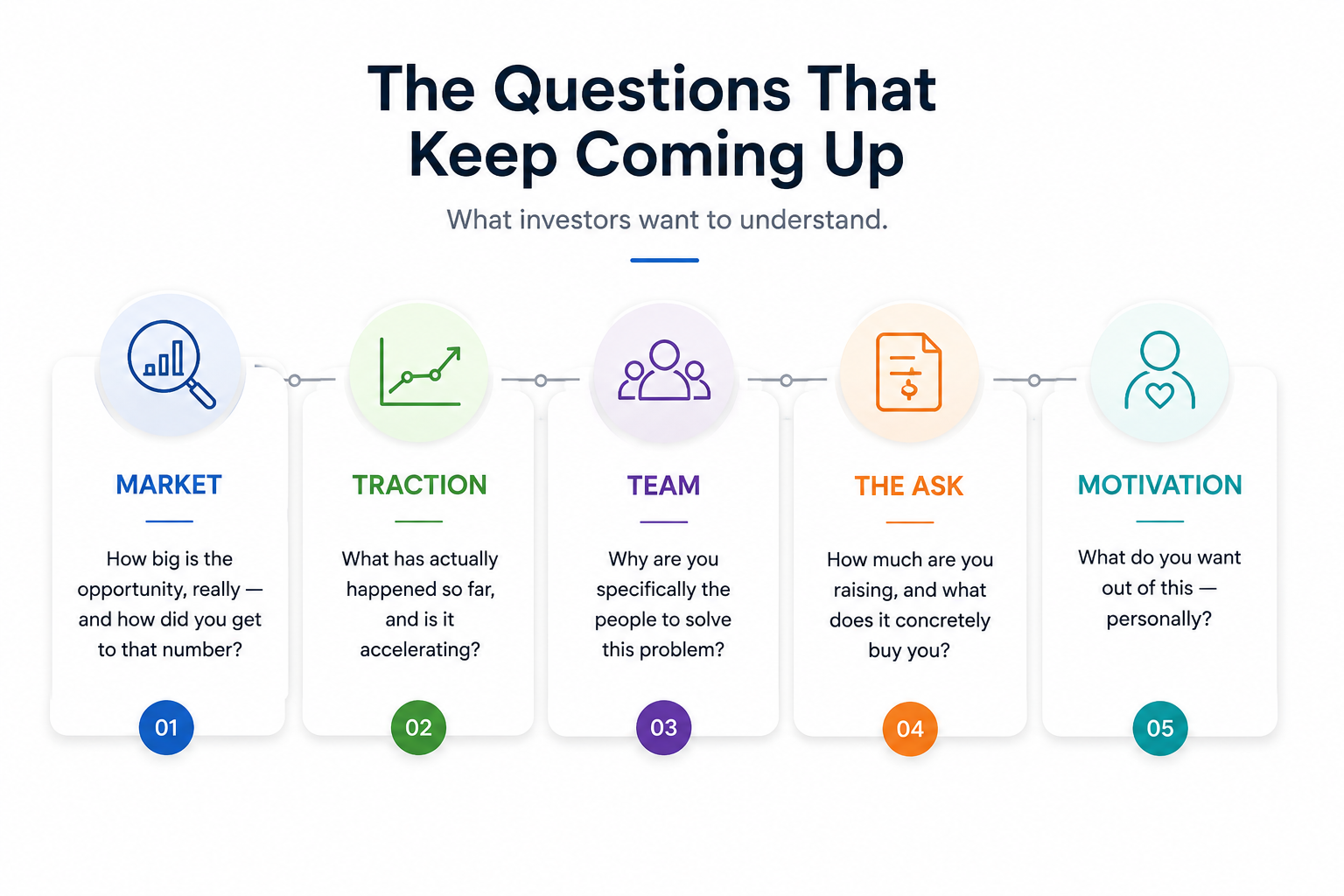
Across pitch events, VC interviews, and research into how early-stage fundraising conversations actually unfold, investor questions tend to cluster into a handful of consistent areas. Not because investors lack imagination, but because they're all trying to de-risk the same core unknowns.
Market. How big is this opportunity, really — and how did you get to that number? Investors are wary of top-down market sizing ("if we just capture 1% of a $50B market"), because it tells them nothing about whether the specific wedge you're going after is actually winnable. They want to understand the methodology, not just the headline figure.
Traction. What has actually happened so far, and is it accelerating? This is less about the absolute scale of your numbers and more about the direction and your understanding of why the trend is moving the way it is. "We're growing fast" is not traction. A month-by-month curve you can speak to is.
Team. Why are you specifically the people to solve this problem? This goes beyond listing credentials — investors want to understand the connection between the team's background and this particular bet. Leighanne Levensaler, a San Francisco-based angel investor, described deliberately building a case against investing in every company before a meeting, specifically to test whether the team's story could survive genuine scrutiny.
The ask. How much are you raising and what does it concretely buy you? A range with no breakdown of use of funds signals that the financial thinking hasn't been done. Investors want to hear what the capital converts into — specific milestones, timeline — and what it positions the company to do next.
Motivation. This one catches founders off guard more than any other. One investor profiled by RBCx said the question that most consistently stumps founders is simply: "What do you want out of this?" Not the company. You, personally. Investors are trying to gauge whether someone has the genuine stamina for what's often described as a ten-year journey — not just the excitement of a first launch.
Why Follow-Up Questions Are Where Most Pitches Actually Fall Apart
Here's what most pitch advice misses: it prepares you for the first-order question, not the one that comes after it.
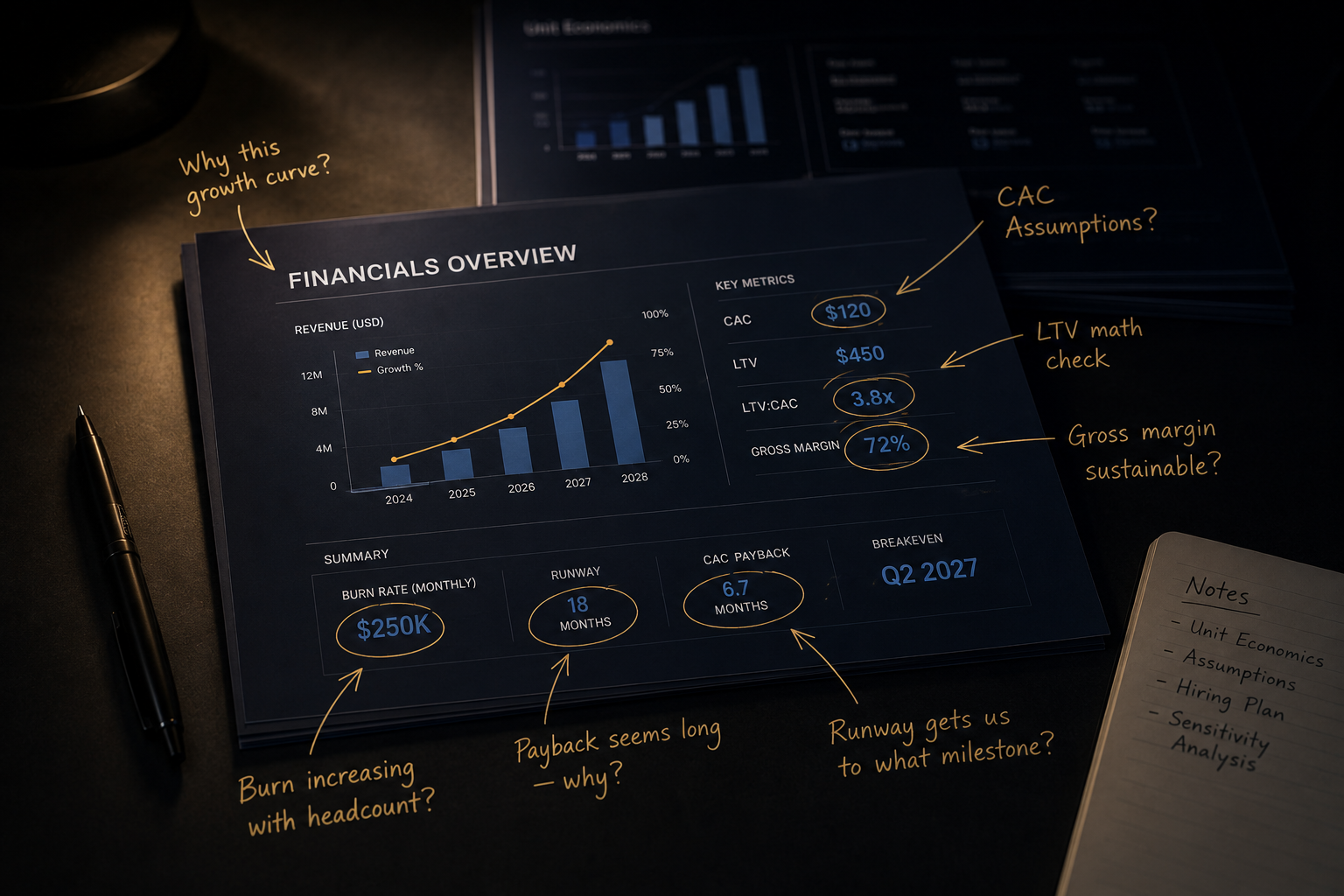
Founders spend hours rehearsing answers to "what's your CAC?" and "who are your main competitors?" and then get derailed when an investor immediately follows up with "how does CAC vary by customer segment?" or "what's your win rate against that competitor specifically?" The follow-up isn't harder to answer than the original question. It's just harder to fake. If your first answer was grounded in genuine understanding, the follow-up is easy — the same understanding that produced the first answer produces the second naturally. If your first answer was memorised, the follow-up will surface that.
This is why preparing only a list of anticipated questions consistently fails. The investor isn't working through a script either.
Tim Berry, co-founder of Borland International, described the live pitch environment plainly: "Very few pitches last through a whole slide deck without investors interrupting with questions. If having your pitch sequence disturbed bothers you, keep your day job." The ability to move fluidly between topics — to answer what's actually being asked rather than what you hoped would be asked — is a skill that only comes from having genuinely internalised your business, not from rehearsing a presentation.
The founders who handle Q&A well aren't the ones with the slickest answers. They're the ones who show their thinking process in real time, reason through things out loud, and know their numbers well enough that the questions don't feel like ambushes. A study from Zamora Design noted that investors can typically identify preparation quality within the first three questions of a meeting — not because they're looking for a polished performance, but because genuine understanding and bluffed answers sound noticeably different.
Honest Preparation Isn't Performance
None of this means you need to memorise a hundred possible questions or become a different person in the room. Composure under pressure helps, but it tends to come from actually knowing your business — not from practising confidence as a separate skill.
What it does mean is that preparation goes deeper than the deck. It means sitting with the hard questions before an investor does — about your unit economics, your market dynamics, what happens if your key assumption turns out to be wrong — until you've genuinely worked through them rather than flagged them for later.
The worst version of preparation is memorising answers to questions you expect. The best version is knowing your business well enough to reason through the ones you didn't see coming.
What This Means in Practice
The clearest practical step is also the most obvious: get more practice conversations with people who will actually challenge you. Friends and co-founders are useful for many things, but they're rarely going to push on your market sizing with the same instinct as someone who's sat through hundreds of pitches.
That's the specific gap Startup Pitch Analyser was built around. It's a live, AI-led practice session that asks the kind of follow-up questions real investors ask, based on your actual pitch. After each session, you get a structured evaluation report showing where your answers held up and where the gaps were — before those gaps show up in a meeting that counts.
The goal isn't to sound rehearsed. It's to walk in already knowing your business as well as the questions will assume you do.
If you want to find out where your pitch stands up and where it doesn't before it counts, Startup Pitch Analyser runs a live AI investor session on your actual deck and delivers a full evaluation report — so you know exactly what to fix before the real meeting.