How Startup Funding Rounds Work: Pre-Seed to Series B Explained
How startup funding rounds work, from pre-seed to Series B — the instruments, milestones, and what triggers each round, with 2026 global benchmarks.
Startup funding doesn't happen in one big cheque. It happens in rounds — separate raises, spaced months or years apart, each one tied to a specific stage of proof. Founders who understand why the rounds are structured this way raise faster and dilute less than founders who treat every raise as a scramble for cash.
Here's how startup funding rounds actually work, from the first pre-seed cheque to a Series B — and what has to be true before each round opens.
How do startup funding rounds work?
Startup funding rounds are staged capital raises, where a company sells a slice of equity in exchange for the money it needs to reach its next major milestone. Each round is priced on what the company has proven so far, and the money is meant to buy the evidence required for the round after it.
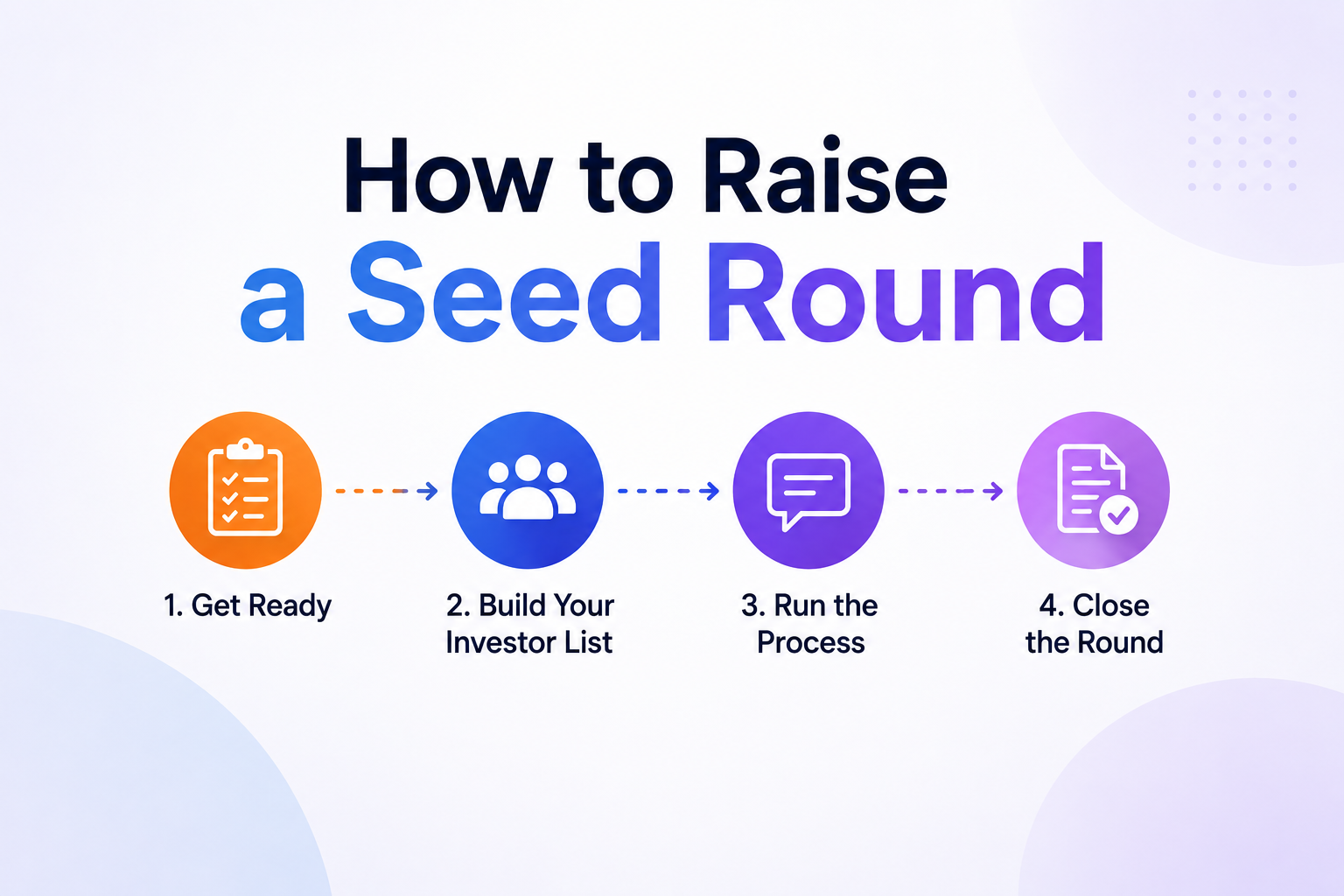
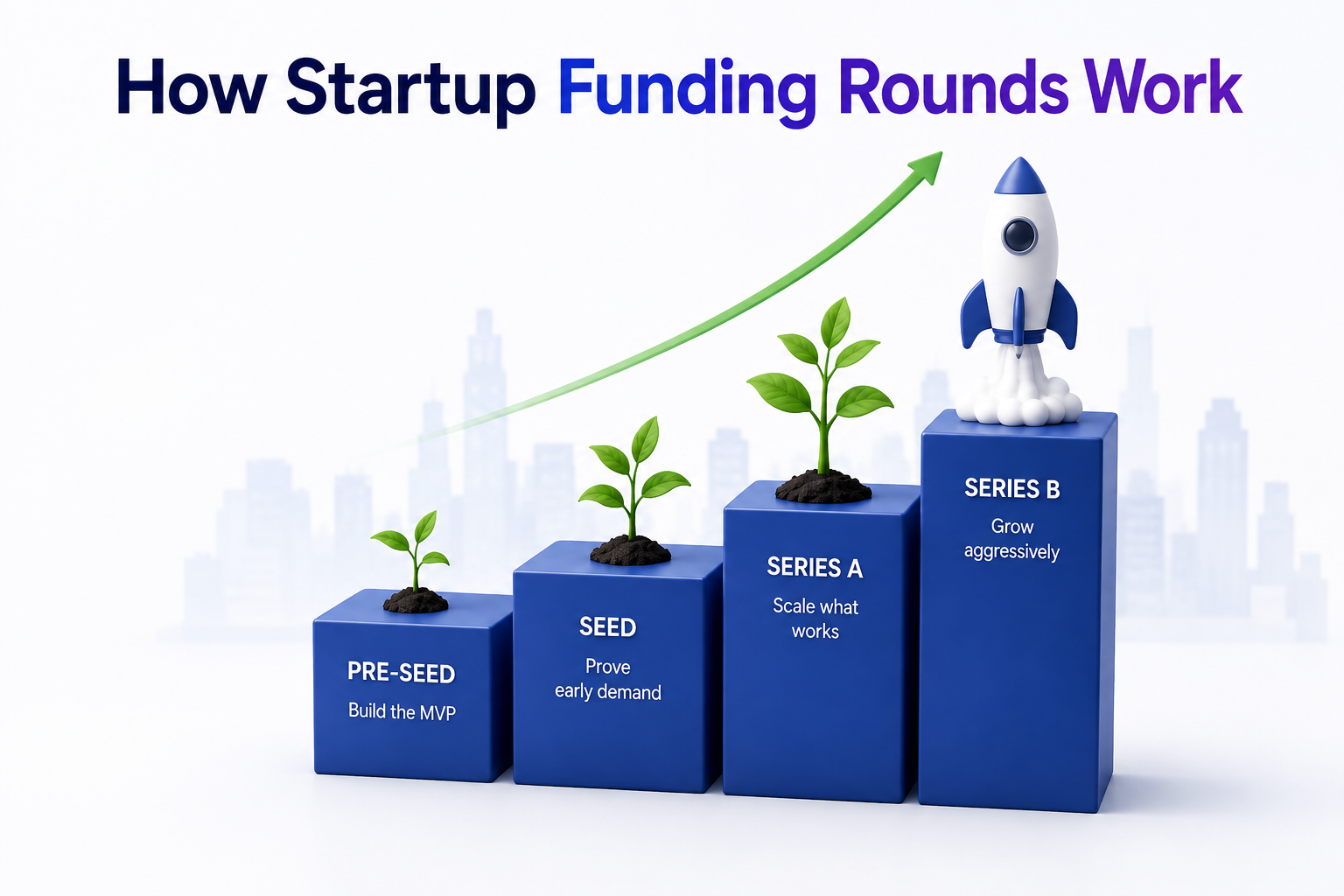
That's the core logic. Pre-seed money buys a product. Seed money buys early customers. Series A money buys repeatable growth. Series B money buys scale. You don't raise the next round because time passed — you raise it because you hit the milestone that makes the next round possible.
The startup funding journey at a glance
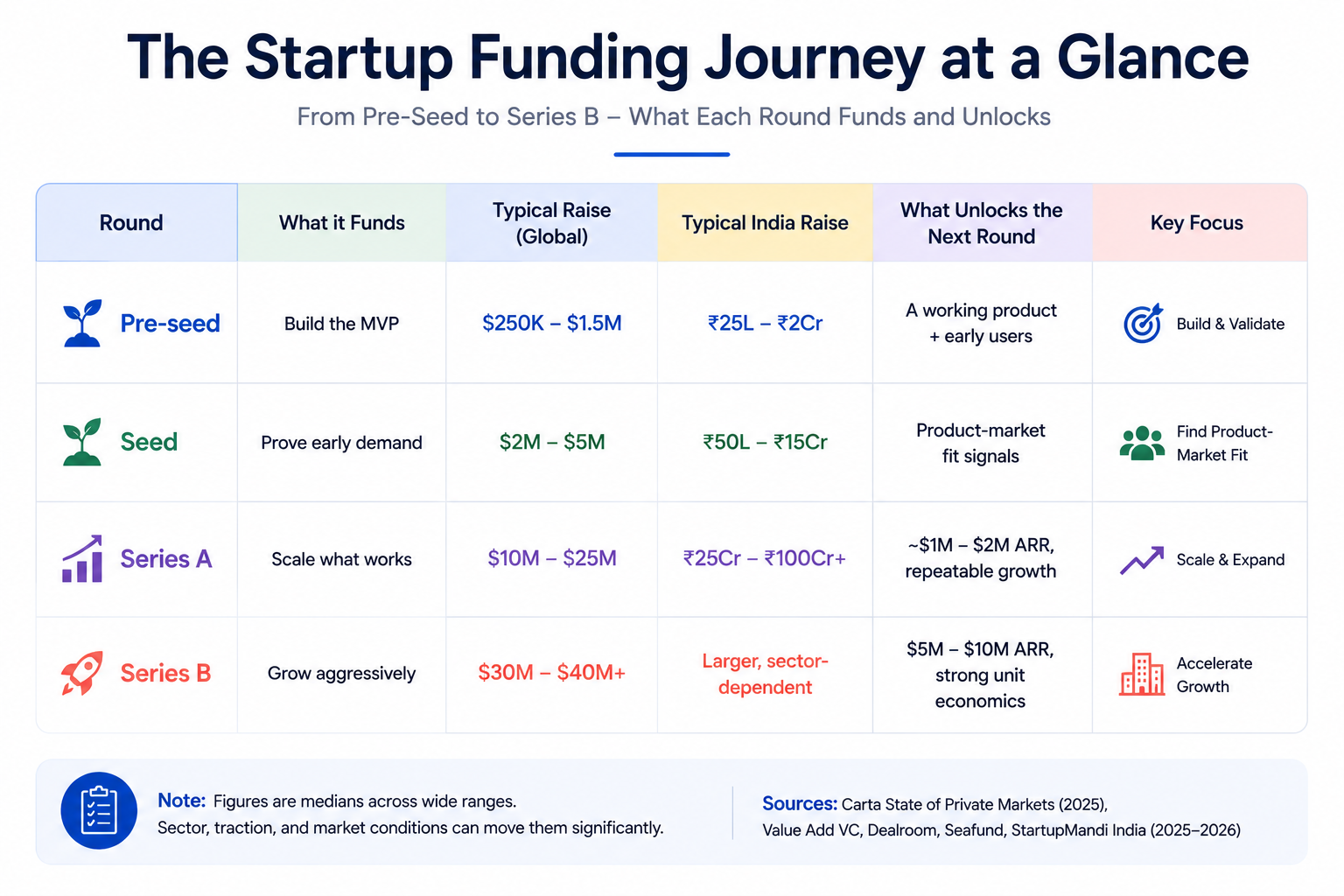
Sources: Carta State of Private Markets (2025), Value Add VC, Dealroom, Seafund and StartupMandi India data (2025–2026). Figures are medians across wide ranges — sector and traction move them significantly.
How does pre-seed funding work?
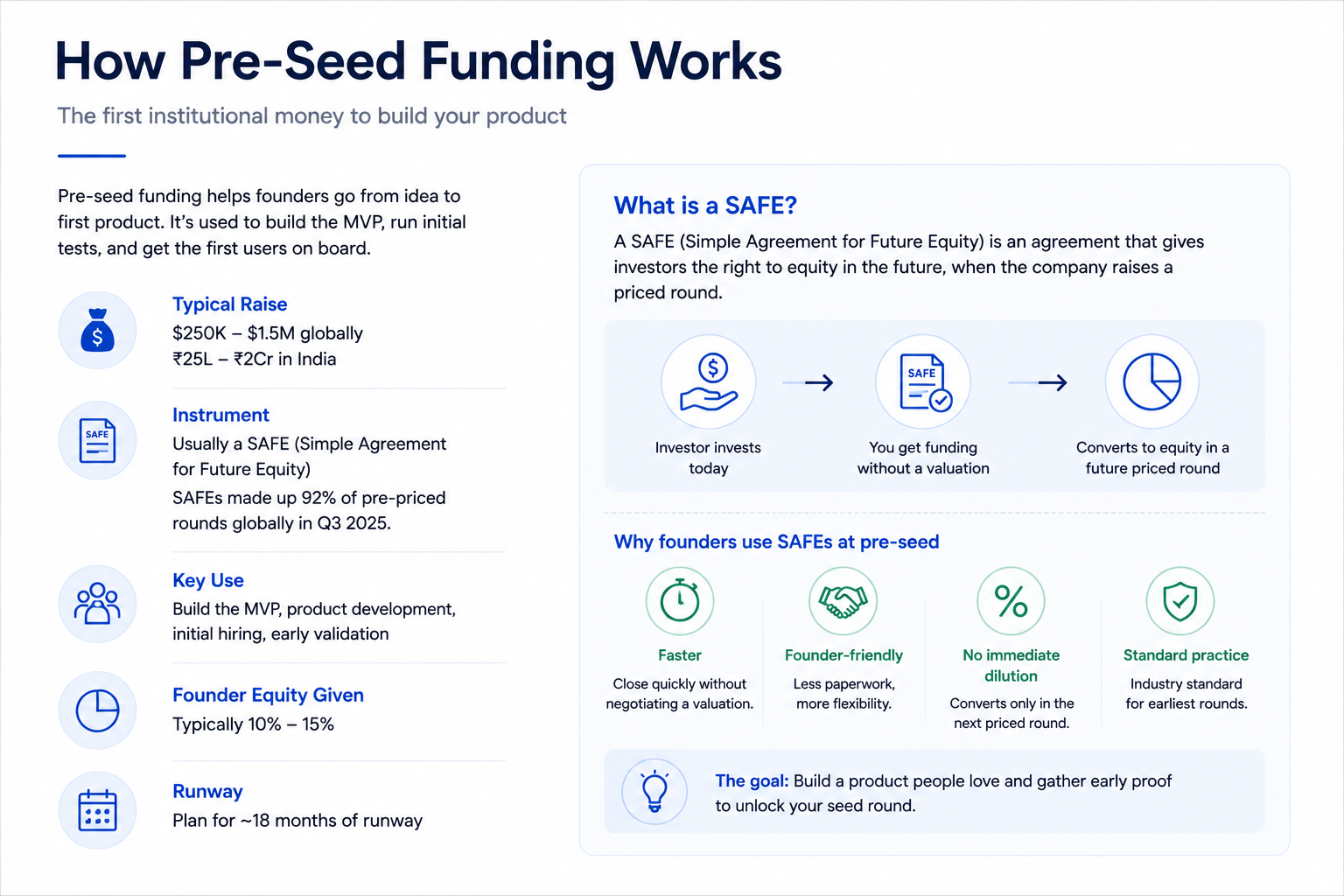
Pre-seed is the first institutional money, used to build a first version of the product before there's meaningful revenue. Globally, most pre-seed rounds land between $250K and $1.5M; in India, roughly ₹25 lakh to ₹2 crore is common (Startups.com; StartupMandi, 2026).
Almost all pre-seed rounds use a SAFE, a Simple Agreement for Future Equity, rather than a priced equity round. SAFEs made up 92% of pre-priced rounds globally in Q3 2025 (Carta). The investor isn't buying priced shares yet; they're buying the right to shares later, when you raise a priced round. Founders typically give up 10–15% and should plan for about 18 months of runway.
How does seed funding work?
Seed funding works by pricing your early evidence and giving you the runway to prove product-market fit. By seed, investors want a working product with real users, not a prototype. Global seed rounds typically run $2M–$5M (median ~$2.5M–$3M); Indian seed rounds commonly fall between $0.5M and $3M (Seafund, 2025).
Seed rounds split roughly in half: priced rounds (a formal Series Seed Preferred, more common above $3M, with a lead investor) and post-money SAFEs (faster, common under $3M, no board seat). Median founder dilution sits near 20% (Carta, 2026). The traction bar is concrete — for SaaS, roughly $5K–$50K in monthly recurring revenue; for enterprise, a handful of paying customers.
How does Series A funding work?
Series A is the first major priced growth round, taken on once a startup has validated demand and needs capital to scale. This is usually the first time a founder brings on a lead institutional investor, a board seat, and formal due diligence. Global Series A rounds run $10M–$25M (median ~$12M–$15M) at pre-money valuations that hit record highs near $45M–$49M in 2025 (Carta, Dealroom).
The evidence bar is the hard part. Most B2B SaaS companies need around $1M–$2M in ARR with strong, repeatable growth before a Series A investor engages. The round funds the go-to-market engine — sales, marketing and the systems that turn a working product into predictable revenue.
How does Series B funding work?
Series B funds aggressive scaling once a repeatable growth engine already exists. The median Series B in 2026 is around $35M on a post-money valuation of roughly $120M–$160M (Value Add VC, 2026). To raise it cleanly, most companies need $5M–$10M ARR, growth of roughly 80–120% year over year, and a clear path to healthy unit economics.
Series B is also where earlier over-valuation catches up with companies. A startup that raised an inflated Series A and grew steadily but not explosively can face a flat or down round — not because the business failed, but because the earlier price got ahead of the numbers.
What actually triggers the next round?
Milestones trigger rounds, not the calendar. Investors at each stage are underwriting a specific question: can this team hit the milestone that makes the next round investable? Raising too early, with thin metrics, is now punished more than raising slowly. The average gap between seed and Series A has stretched to around 616 days (Pitchwise, 2026), and investors aren't penalising the wait — they're penalising early raises that drag.
Priced rounds vs SAFEs: how the money is structured
Early rounds usually use SAFEs or convertible notes; later rounds are priced. A SAFE lets you take money now and set the valuation later, using a valuation cap and sometimes a discount. A convertible note works similarly but behaves like debt — it accrues interest and has a maturity date. A priced round sets a valuation today and issues actual shares, which is why leads, board seats, and heavier diligence show up at seed and beyond.
Why most startups don't make it to the next round
It's worth being honest about the funnel. Only about 30–38% of seed-funded startups go on to raise a Series A, down from roughly 50% in the 2018–2021 cycle (Startups.com; Value Add VC, 2025–2026). The other two-thirds bridge, get acquired, settle into a smaller business or run out of cash.
That drop isn't a verdict on founder quality. The market re-priced, and the bar for each round moved up. The founders who cross cleanly tend to raise for the next milestone rather than the biggest cheque available, and they walk into each round already able to answer the questions that stage will ask. Practising those questions in advance, for example with Startup Pitch Analyser, is one way to find the gaps before an investor does.
Frequently asked questions
How long does it take to go from one round to the next?
Typically 12–24 months. Pre-seed to seed runs roughly 12–18 months; seed to Series A now averages around 616 days globally (Pitchwise, 2026).
Do you have to raise every round in order?
No. Some founders skip pre-seed, and profitable companies sometimes skip later rounds entirely. The sequence is a common path, not a rule.
What's the difference between a SAFE and a priced round?
A SAFE defers the valuation to a future priced round using a cap and discount; a priced round sets the valuation now and issues shares immediately, usually with a lead investor and board seat.
Is Series B the last round?
No — companies can raise Series C, D, and beyond, or reach profitability and stop raising. Series B simply funds the scaling phase after product-market fit is proven.