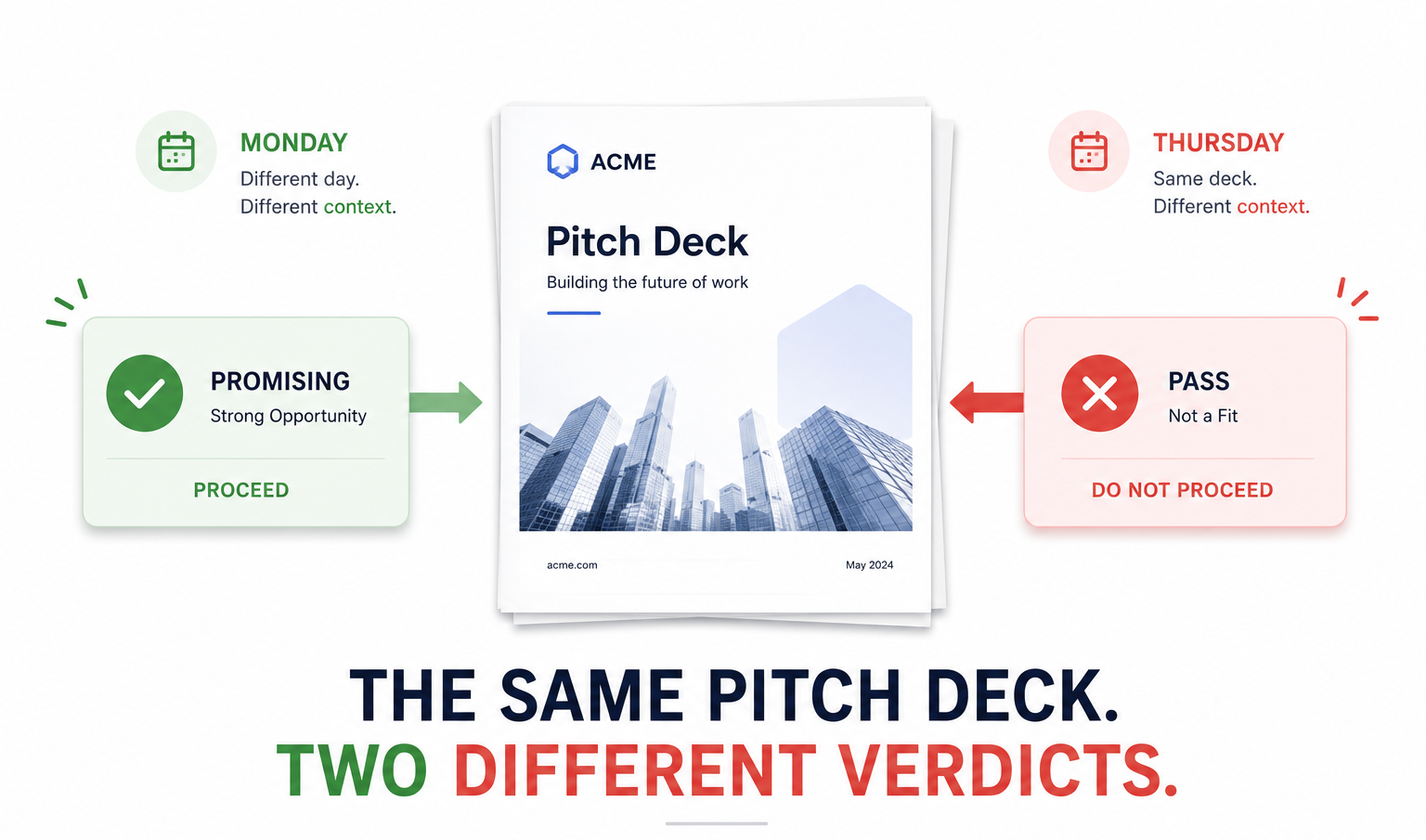
The Financials Slide: What It Really Reveals
The financials slide in your pitch deck reveals how you think, not just your numbers. Here's what investors look for in financials and how to get it right.
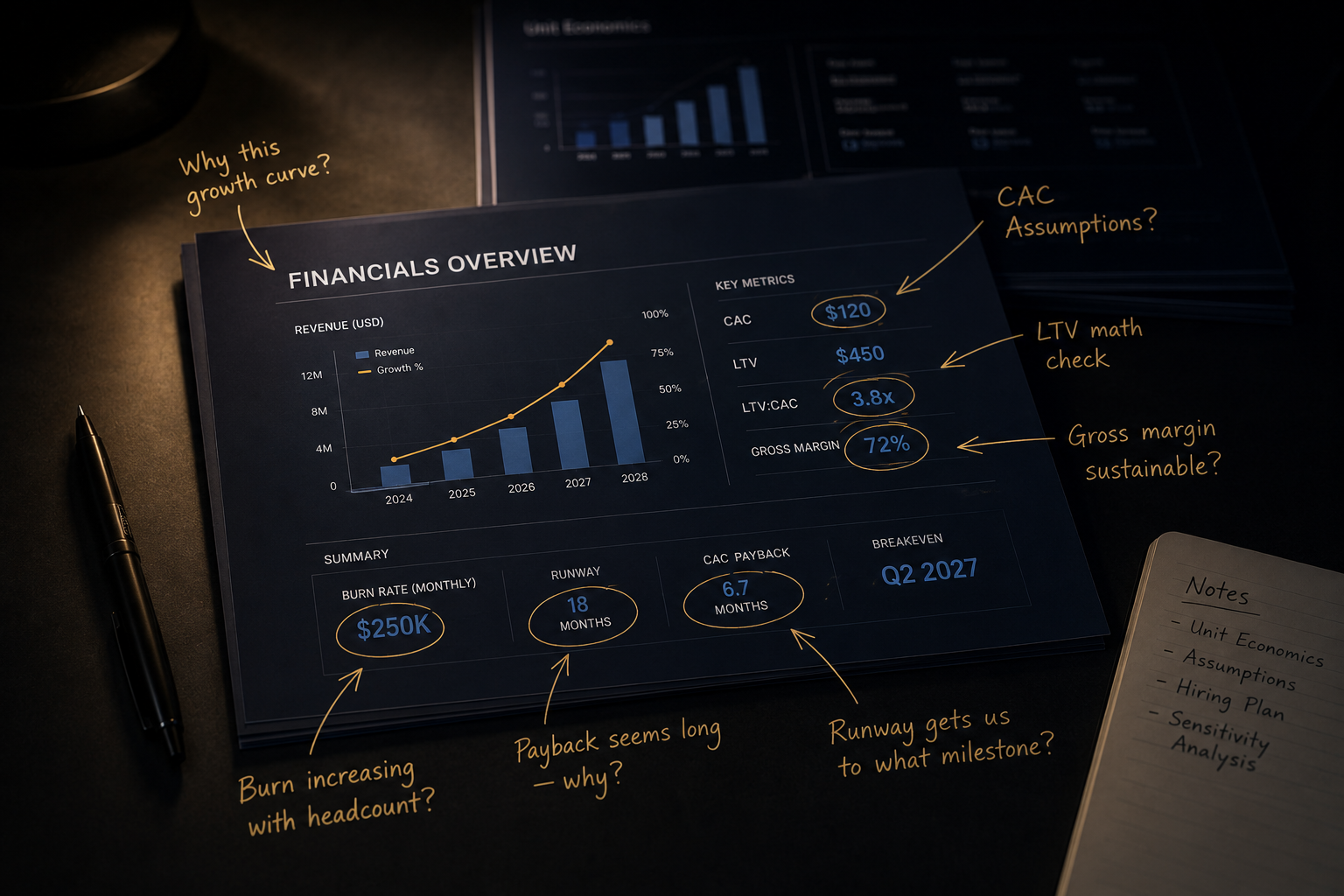
Most founders build the financials slide last, at midnight, the day before the meeting.
They drop in a hockey-stick chart, pick a revenue number that feels ambitious but not insane, and hope no one studies it too closely.
Then they walk into the room and watch the investor spend more time on that one slide than on the product they spent two years building.
This surprises almost everyone. But the financials slide in a pitch deck quietly gets the second-most attention of any slide — sometimes more than the product slide itself. And the reason has almost nothing to do with the numbers.
Why Investors Look at the Financials Slide
Here is the part founders misread: investors do not study your financials because they believe them.
They know early-stage projections are fiction. No one can tell you what revenue you will do in year three. A seed-stage founder claiming a precise five-year forecast is not being credible — they are being imaginative.
So why the scrutiny?
Because the financials slide reveals how the founder thinks.
It is a proxy for rigor. When an investor reads your numbers, they are not checking whether you will hit $10M in 2028. They are checking whether you understand the machine that would have to produce that $10M. Do the assumptions connect to reality? Does every line have a reason to exist? Does this founder know the two or three numbers that actually drive their business — or did they reverse-engineer a spreadsheet to land on a figure that looked fundable?
A clean financial model with transparent assumptions signals a founder who thinks clearly. A screenshot of optimistic numbers with no logic underneath signals the opposite — and investors read that signal instantly.
What Investors Look For in Financials
When an investor studies your financial model, a specific set of questions runs in the background:
Does the unit economics make sense? Are the assumptions logical and defensible? Does the founder understand the key drivers of the business or only the outputs?
This is why a breakdown of unit economics is one of the better predictors of fundraising success. Decks that clearly discussed pricing strategy have been found to be meaningfully more likely to raise. Not because pricing is magic, but because a founder who can explain pricing is a founder who has thought about how the business actually makes money.
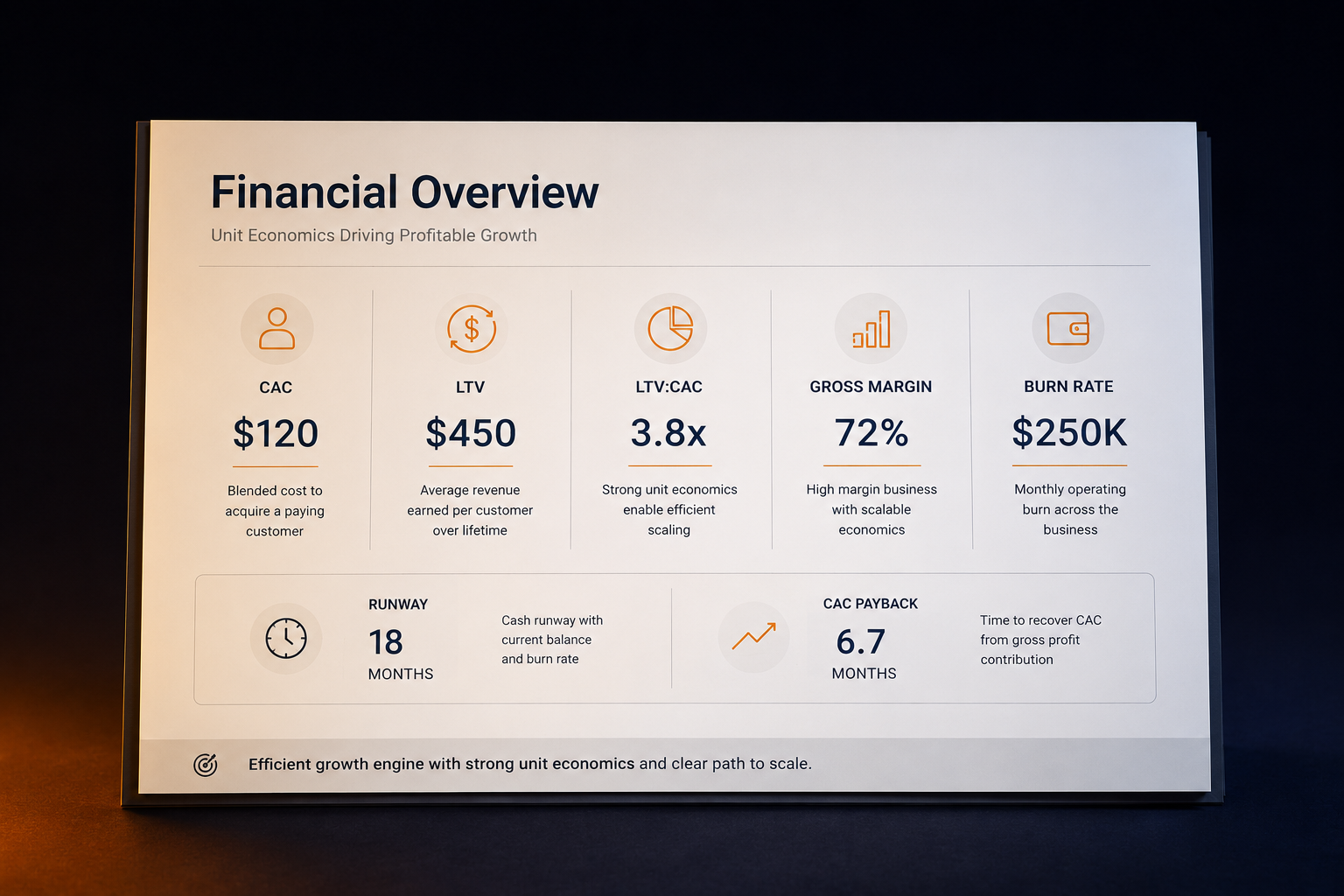
The financials slide is not asking you to be an accountant. It is asking you to prove you understand your own economics. The founders who clear that bar can break down the handful of metrics below without flinching.
The Numbers That Actually Matter
You do not need forty rows of a P&L on one slide. You need to show you understand the levers. These are the ones investors check:
Customer Acquisition Cost (CAC)
What it costs you to win one customer. If you do not know this number, you do not yet know whether your growth is affordable.
Lifetime Value (LTV) and the LTV:CAC ratio
How much a customer is worth over their lifetime versus what they cost to acquire. Investors look for a healthy ratio — commonly cited around 3:1 — because it shows the business compounds rather than leaks.
Gross margin
What is left after the direct cost of delivering your product. High, durable margins are what make a startup worth venture money in the first place. A "software" company running on 30% margins invites hard questions.
Burn rate and runway
How much cash you spend each month, and how many months that cash buys you. This tells an investor whether the round you are raising actually gets you somewhere — or just postpones the next emergency.
CAC payback period
How long it takes to earn back what you spent acquiring a customer. The shorter it is, the faster you can reinvest and grow without raising endlessly.
You will not put all of these on a single slide. But you should be able to speak to every one of them the moment an investor asks — because they will.
Show the Mechanics, Not the Hockey Stick
The fastest way to understand what investors want is to compare two versions of the same claim.
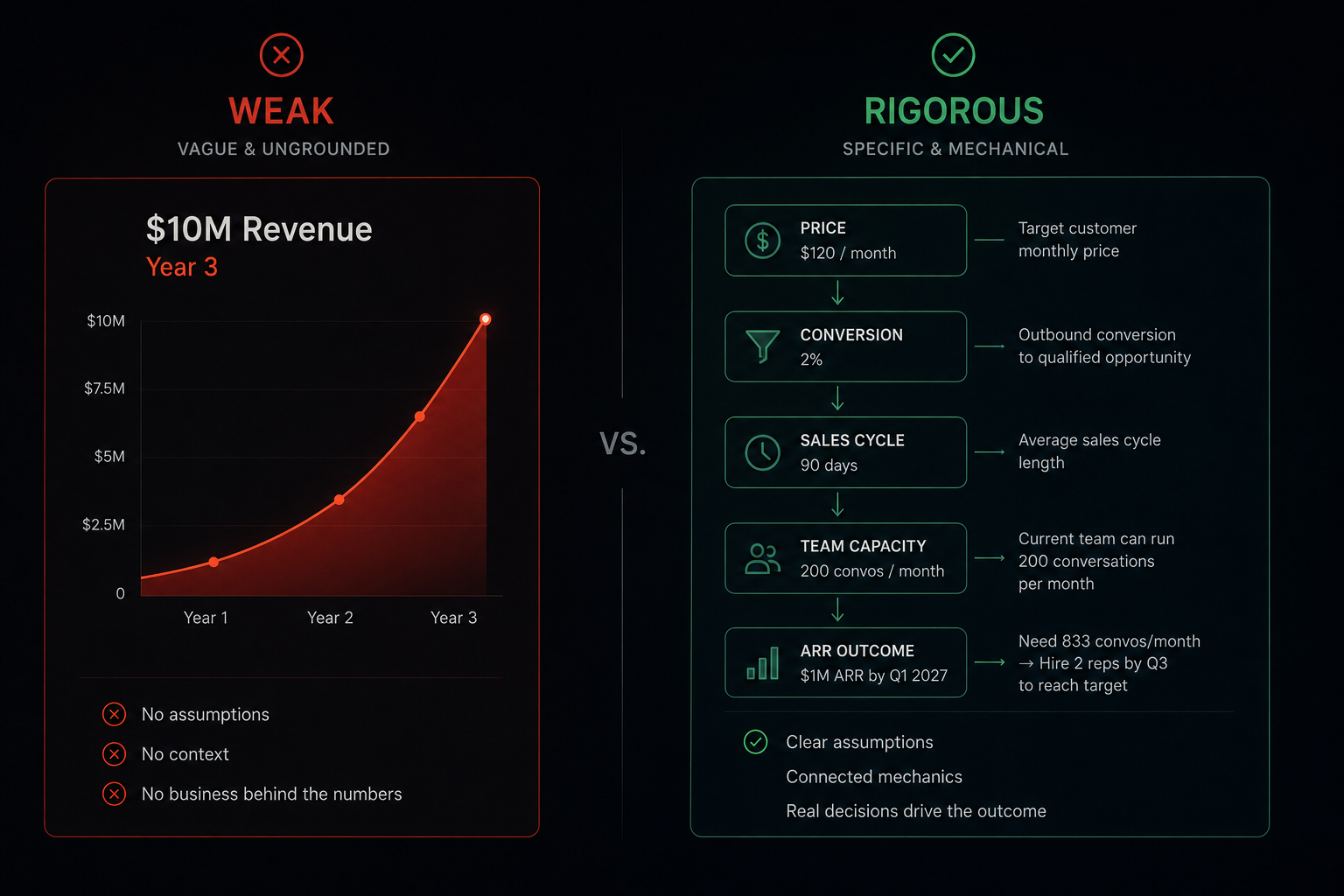
The weak version:
"We project $10M in revenue by year three."
This tells an investor nothing except that you can draw a line that goes up. There is no business inside it.
The rigorous version:
"Our target customer pays $120/month, has a 90-day sales cycle, and churns at 5% monthly. At 2% conversion on outbound, we need 833 conversations per month to reach $1M ARR. We can run 200 conversations per month with the current team, so we need to hire two more sales reps by Q3. That gets us to $1M ARR by Q1 2027."
Same ambition. Completely different signal.
The second version shows you understand the actual mechanics — the inputs, the constraints, the hiring decision the model forces, the timeline that falls out of it. It proves you are not presenting assumptions as predictions. You are showing the engine.
That is the whole game. The hockey stick says trust me. The mechanics say here is exactly how it works, and here is what would have to be true.
The Translation Gap on This One Slide
There is a quiet gap between what founders put on the financials slide and what investors take away from it.
The founder writes "10x growth in year three" and means we are ambitious. The investor reads "10x growth in year three" and hears these numbers have no connection to reality.
The founder shows a clean $50B market and a steep revenue curve and means huge opportunity. The investor hears this person has not done the segmentation and cannot tell me how the first dollar actually gets made.
The problem is not dishonesty. It is perspective. Founders present the business the way they see it from the inside, full of conviction. Investors evaluate it from the outside, looking for the cracks. The financials slide is where that gap is most visible, because numbers cannot hide behind a good story.
Closing the gap is not about smaller ambition. It is about making your ambition legible — backing every number with an assumption an investor can poke at and find solid.
Before You Send the Deck: A Quick Financials Check
Run your financials slide through these questions before an investor does:
- Does every number trace back to an assumption you can defend out loud?
- Can you explain your unit economics — CAC, LTV, margin — without reaching for the spreadsheet?
- Have you shown the mechanics of how you reach your target, not just the target?
- Does your burn and runway show that this round actually gets you to a meaningful milestone?
- Would the model survive a smart, skeptical follow-up question?
If any answer is no, that is the gap to fix before it costs you the room.
The Real Signal
Investors are not looking for a founder who predicted the future correctly. That founder does not exist.
They are looking for a founder who understands their own business at a level most do not — who can show the assumptions, walk the unit economics, and connect every number to a real decision. That founder signals rigor, clarity, and honesty before they say a word about valuation.
That is what the financials slide really reveals. Not whether your numbers are right. Whether you are someone worth betting on.
You should not learn that your revenue-model slide is confusing during a real investor meeting — that is the most expensive place to find out. Startup Pitch Analyser puts you in an AI-led investor meeting before the real one. It reads your deck, asks the hard follow-up questions real investors ask including the ones about your numbers, and shows you exactly where your financials lose an investor so you can fix it while it still costs nothing.