The First Filter Is Broken — But Not in the Way You Think
The first layer of startup evaluation was designed for a different era of dealflow. The process has not failed — it was built for a volume that no longer exists.
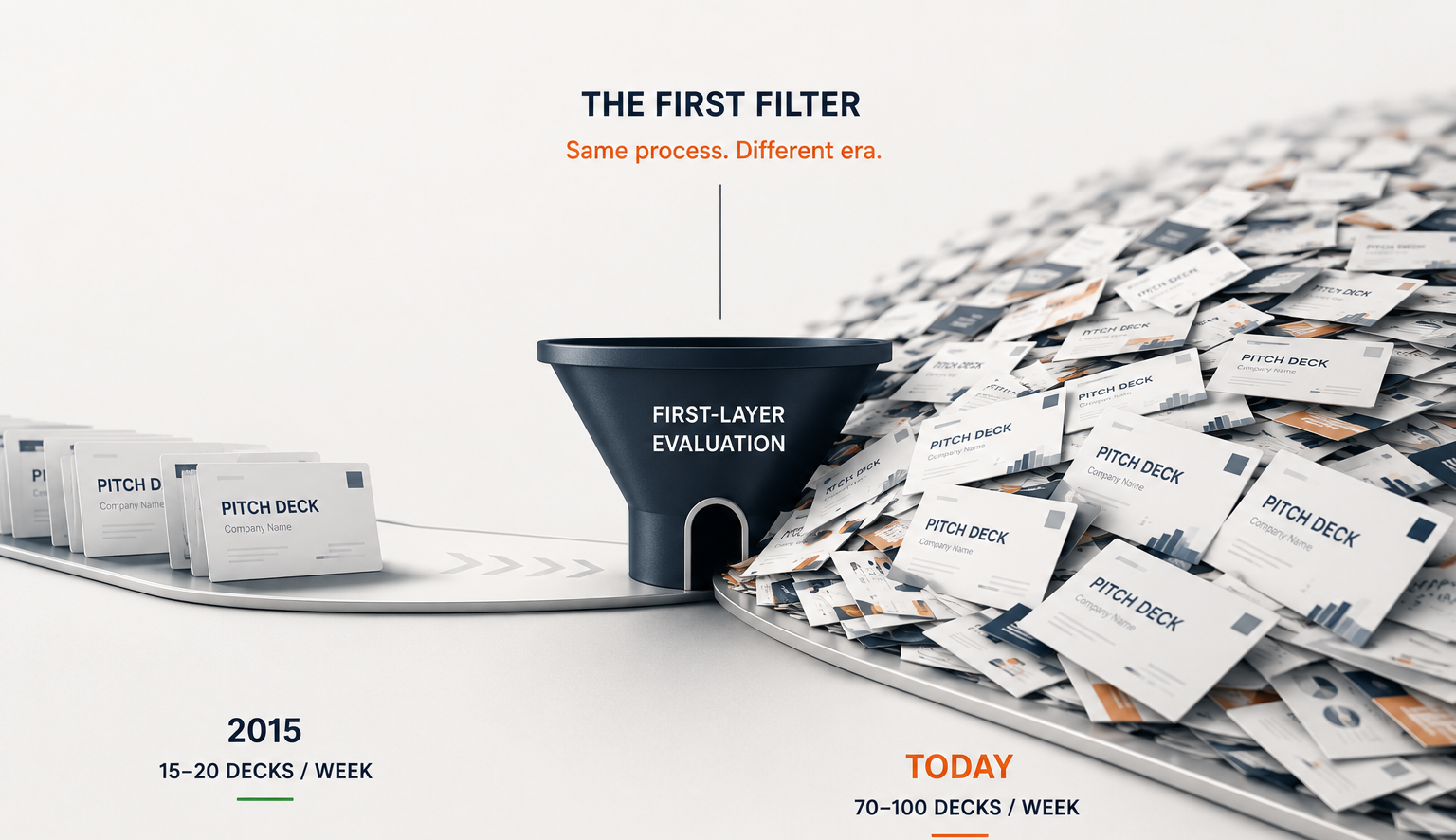
A General Partner at an early-stage fund told me recently that he tracks his time every quarter. Not for productivity reasons for honesty.
He wanted to see where the hours were actually going. Not where he intended them to go. Not where the operating plan said they should go. Where they actually went.
The result was not surprising. It was clarifying.
The majority of his working week was consumed by first-layer evaluation reading inbound startup pitch decks, sorting applications by thesis fit, responding to submissions that were never going to progress, managing the operational overhead of a pipeline that grows faster than any process built to handle it.
The minority went to the work his investors backed him to do, building conviction on live deals, developing relationships with startup founders before they were raising, thinking through where the market was heading and being present in the conversations that actually produced returns.
He was not inefficient. The process was consuming the hours before they reached the work that mattered.
What Does the First Layer Actually Consume?
The first layer of startup evaluation is not one task. It is a collection of activities that, individually, each seem manageable but together absorb more of the week than most funds realise until they measure it.
Reading inbound startup pitch decks that arrived overnight. Sorting applications against thesis criteria. Responding to follow-ups on submissions that were reviewed and passed weeks ago. Coordinating across the team on which deals have been seen and which have not. Managing the queue so nothing falls through the cracks administratively even when the pipeline is above capacity.
None of these tasks are unimportant. The first layer is where the pipeline begins. Getting it wrong means missing good deals or wasting time on the wrong ones. But the cumulative time cost of running the first layer manually is significant and it comes directly out of the hours that would otherwise go to the work that defines fund performance.
The pattern is consistent across nearly every fund I have spoken with. The week starts with an intention to focus on high-leverage work. By Wednesday, the first layer had consumed most of the available hours. By Friday, the team is catching up on what the first layer crowded out earlier in the week. The cycle resets on Monday.
This is not a failing of discipline or time management. It is the predictable output of a process that was designed for a volume of dealflow that no longer exists. When the first layer was built around fifteen or twenty inbound startup pitch decks per week, running it manually made sense. At seventy or a hundred per week, the same process absorbs the majority of the hours simply because the volume demands it. The process has not broken down. It is doing exactly what it was designed to do, it was just designed for a different era of volume.
What Gets Crowded Out?
The cost of a manually-run first layer is not measured in the hours it takes. It is measured in what those hours would have produced if they had gone somewhere else.
Proactive founder outreach gets deferred. The startup founders and a partner met at a conference three months ago, the ones worth following up with before they start raising stay on a list that never gets actioned. By the time they are formally fundraising, the relationship that would have provided warm access does not exist. The fund competes for allocation alongside everyone else.
Deep diligence gets compressed. The reference calls that would have surfaced the real story behind the numbers. The cap table analysis that would have revealed a structural issue. The customer conversation that would have confirmed whether retention was real or seasonal. Each of these individually seems like something that can wait until tomorrow. Collectively, they represent the quality gap between a well-informed investment decision and one made on incomplete information.
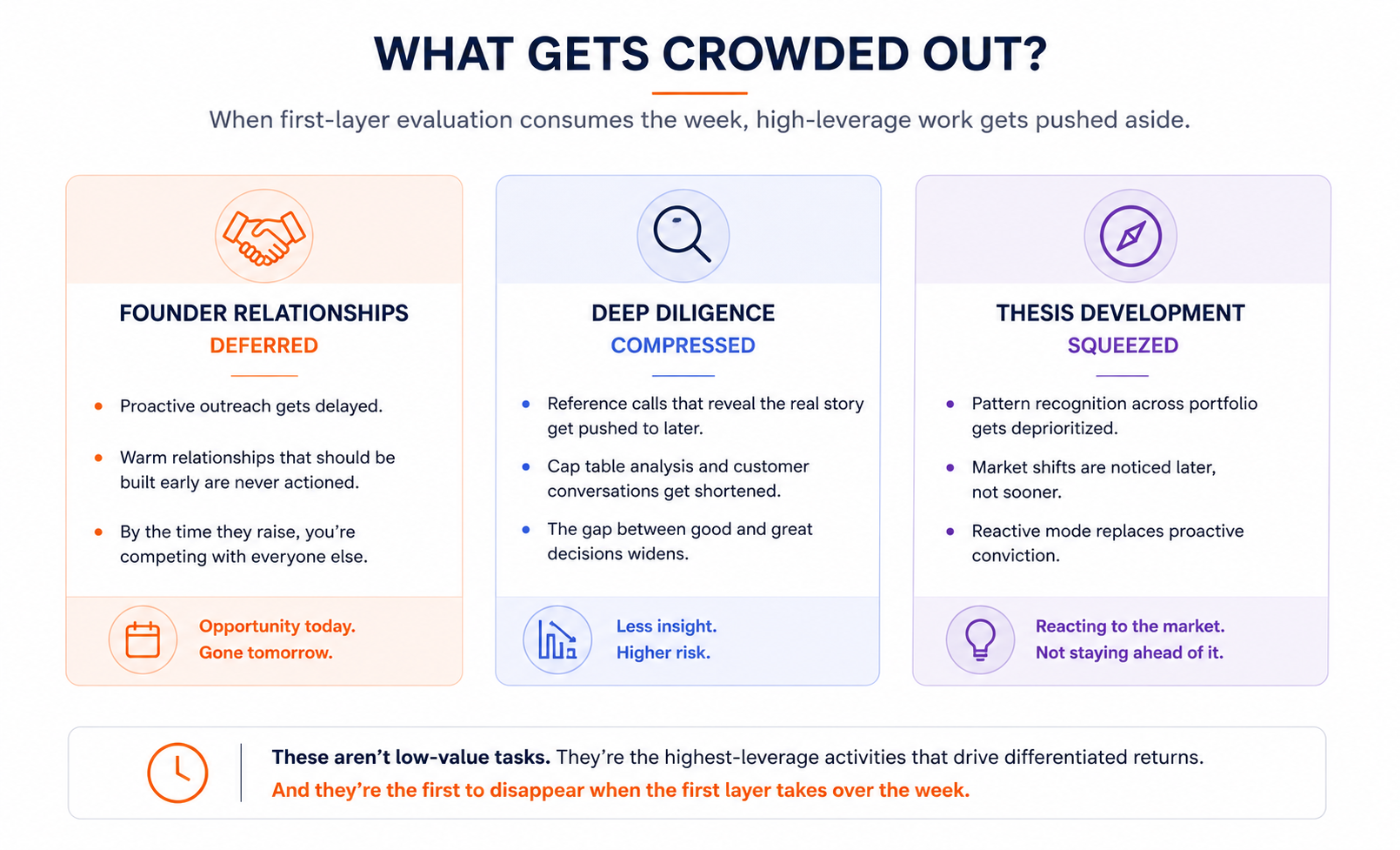
Thesis development gets squeezed. The unstructured time where patterns across portfolio companies get connected, where shifts in the market get noticed before they become obvious, where the conviction develops that produces proactive deal sourcing rather than reactive inbox processing. This is where the best investment theses originate and it is the first thing that disappears when the first layer consumes the week.
The pattern is the same across every fund I have spoken with, regardless of size or geography. The team is not short on capability. They are short on hours because the first-layer process is consuming the hours before they reach the activities that produce the highest returns. The intent is always there. The operating plan accounts for it. The calendar does not, because the first layer fills it first.
Why Is the First Layer the Highest-Leverage Fix?
The insight the best-managed funds share is this: the first layer is not a minor operational detail. It is the foundation of everything else in the evaluation process. When the foundation consumes the majority of the available capacity, everything built on top of it suffers.
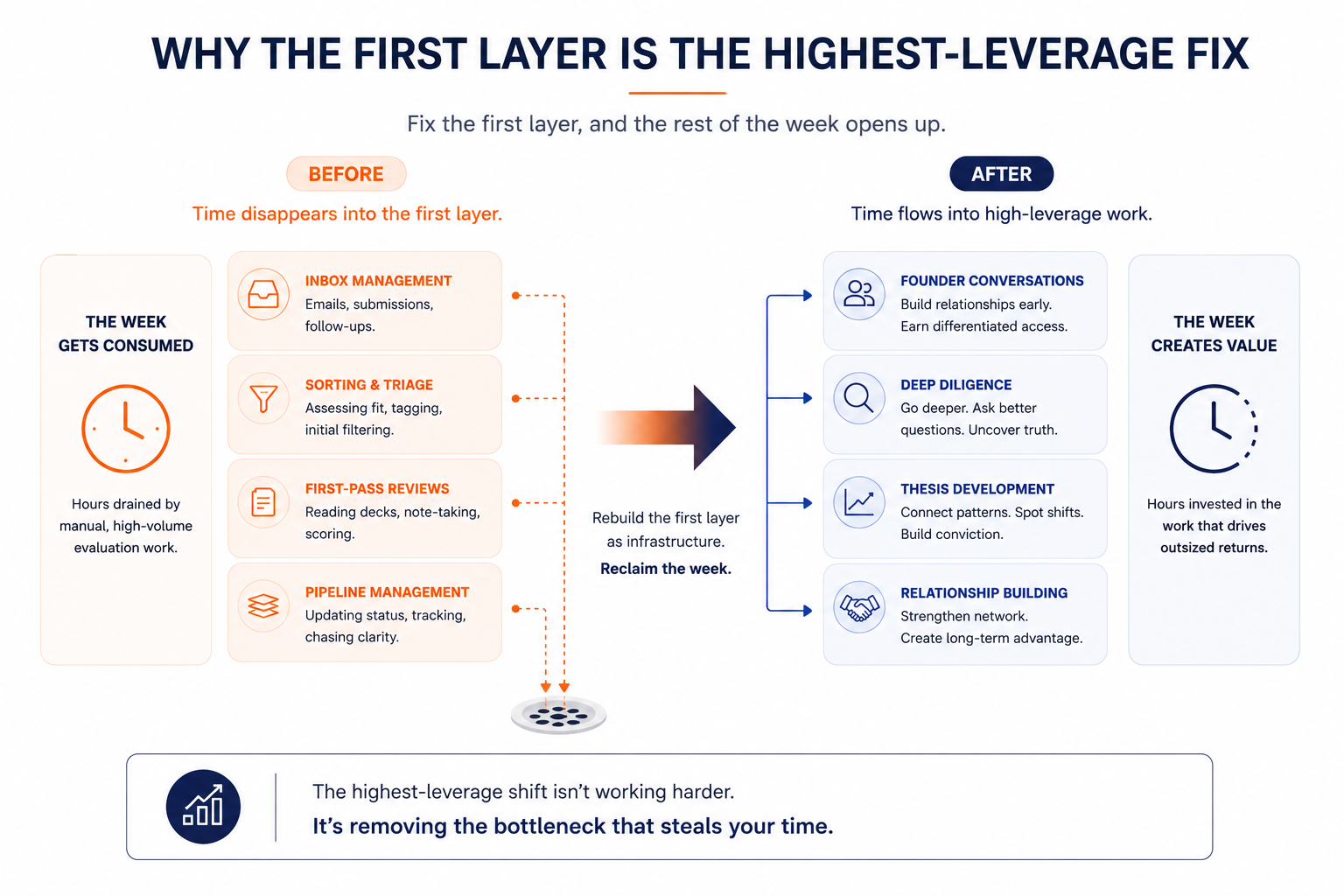
This is an infrastructure problem, not a performance problem. The process is absorbing capacity that should flow to higher-value work. The solution is not to run the first-layer process faster, it is to rebuild the first layer as infrastructure that operates without consuming the hours the team needs for conviction-building, diligence and relationships.
When the first layer operates as structured infrastructure applying the fund's thesis criteria to every inbound startup pitch deck, producing uniform evaluation output and surfacing the deals that meet the bar, the time allocation shifts fundamentally. The hours that were consumed by sorting now go to the work that produces returns.
The investment team's first interaction with a deal starts from structured intelligence evaluation reports, session records, thesis-alignment scoring rather than a cold read of a pitch deck in the inbox. The first conversation with a startup founder is focused and productive because the groundwork has already been done. The diligence goes deeper because time exists for it. The relationships get built because the calendar is not consumed by triage.
This is why the first layer is the highest-leverage infrastructure decision a fund can make. Not because it is the most visible part of the process it is often the least visible. But because every other part of the process depends on what the first layer leaves behind. When the first layer consumes the hours, the downstream work suffers. When the first layer operates as infrastructure, the downstream work gets the full capacity of the team behind it. The leverage is in the reallocation the same team, the same capability, applied to fundamentally different work.
What the Week Looks Like After the Fix
The funds that have rebuilt their first layer as infrastructure describe the same transformation. The week looks fundamentally different.
Monday morning starts with a curated pipeline of thesis-aligned startup deals, each with a structured evaluation already attached. The team's time goes to reviewing structured intelligence on qualified deals not sorting through an inbox to find them. Founder conversations happen earlier and go deeper because the team arrives with context. Diligence is thorough because the hours exist for it. Proactive outreach actually happens because it is no longer competing with the triage that used to consume the week.
The team has not changed. The capability has not changed. What changed is where the hours go and what those hours produce.
The GP who tracked his time told me the most surprising thing was not how much time the first layer consumed. It was how quickly the downstream work improved once the first layer stopped consuming it. Better conversations. Stronger conviction. Deeper relationships. Not because the team was doing anything differently because they finally had the time to do what they were already capable of.
This is what we built Smart AI Investor for a structured first layer that handles evaluation at any volume, so the investment team's hours go to the work that defines their value. See the platform at venturehub360.com/smart-ai-investor
Smart AI Investor is the structured first layer that handles startup evaluation at any volume — conducting AI-led pitch sessions with every founder, researching each startup independently, and delivering IC-ready reports so your investment team's hours go to the decisions that define their value.