After Two Days at Google, I Realized Most Companies Are Not Ready for What's Coming in AI
Discover key insights from the Google Mountain View AI conference. Learn why agentic AI, context-driven systems, and operational intelligence are the future of enterprise software.
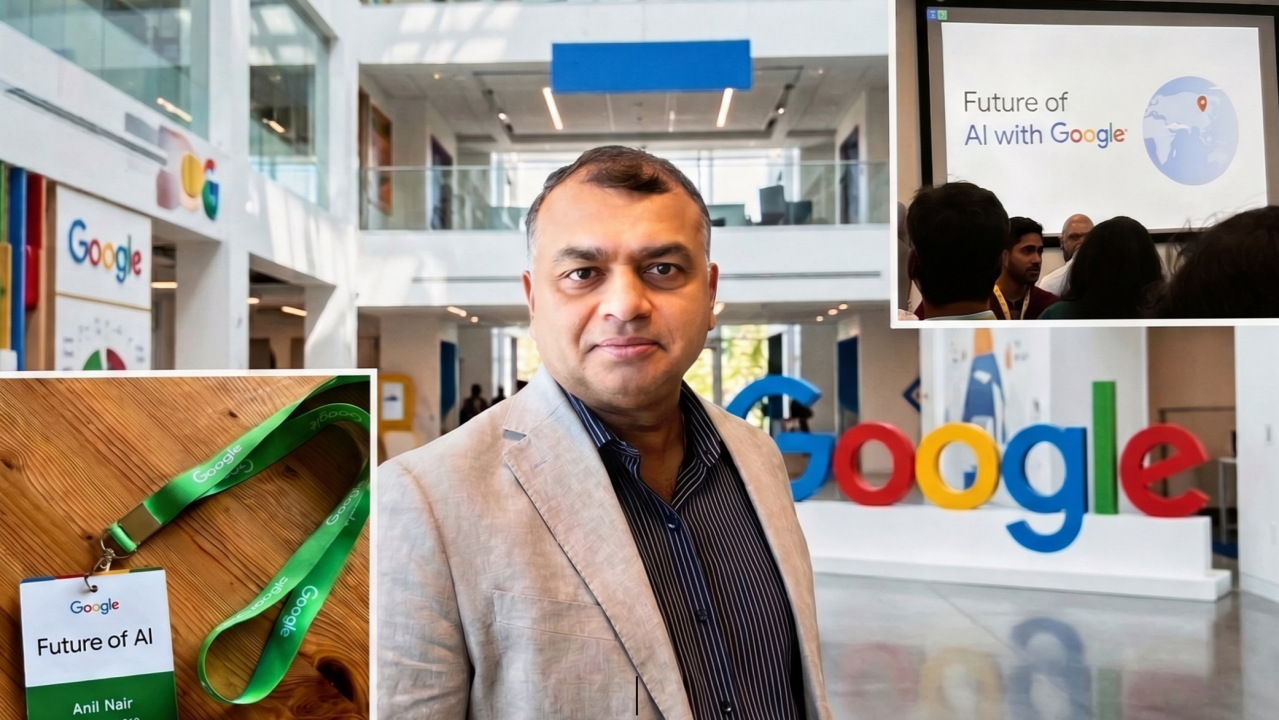
I walked into the conference at Google Mountain View expecting conversations about larger models, faster inference, and the usual race toward "better AI."
Instead, I walked out thinking about something very different.
The future of AI may not belong to the companies with the smartest models. It may belong to the companies that understand context, move faster than everyone else, and build systems humans eventually can't operate without.
For two days in Mountain View, founders, researchers, investors, operators, and enterprise leaders discussed where AI is heading. Somewhere between hallway conversations, packed sessions, and rapid-fire debates about autonomous AI agents, enterprise AI infrastructure, and agentic workflow orchestration, a bigger picture started forming in my mind.
And honestly, it feels like we are entering a completely different era of software.
The Rise of Master Intelligence
One of the first ideas that caught my attention was the concept of what some people called "master intelligence." Today, most people still think of AI as a chatbot waiting for instructions. But the conversations at Google pointed toward something much bigger.
Imagine giving AI a high-level business objective instead of a prompt: "Help us launch our product in Europe." The system wouldn't just answer. It would create specialized autonomous AI agents on its own. One agent researching regulations. Another analyzing competitors. Another studying pricing. Another preparing localized marketing. Another evaluating operational risks. An orchestrator coordinating all of them together in real time. It would feel less like software and more like an autonomous organization forming dynamically around an objective.
What struck me personally was how closely this aligned with what we have been building at AIQoD from day one. The realization that humans may no longer operate tools directly, but instead supervise intelligent systems operating on their behalf, felt incredibly significant.
And that shift is massive.
Chat Interfaces Are Becoming the New Operating System
Another recurring theme was that chat interfaces are slowly becoming the new operating system. Not by replacing every application tomorrow, but by becoming the primary layer through which people interact with enterprise software and AI workflow automation systems. Instead of learning complex dashboards or navigating endless workflows, users will increasingly just say: "Get this done." The software underneath becomes invisible.
What matters then is not who has the prettiest interface. It's who has the deepest understanding of the user, the company, and the workflow context.
That's where another fascinating discussion emerged: the move from knowledge graphs to context graphs. A knowledge graph stores information. A context graph understands relationships, intent, operational history, behavioral patterns, organizational memory, and execution context. That distinction felt extremely important.
It also reinforced something I've believed for a long time: the future AI moat will not simply be models. It will be proprietary context. In a world where models are increasingly commoditized, contextual AI and operational intelligence become incredibly valuable. Any horizontal AI system can access public internet knowledge. But it cannot easily replicate years of customer interactions, workflow history, operational patterns, internal decisions, organizational learning, and behavioral signals.
That data no longer becomes just information. It becomes intelligence.
Why Context-Driven AI Systems Matter
One of the strongest signals throughout the conference was the emergence of context-driven AI systems and multi-agent enterprise systems. The future of enterprise AI may not be defined by who owns the largest model. It may be defined by who owns the richest operational context.
That includes:
- organizational memory
- workflow behavior
- customer interactions
- enterprise decision patterns
- internal execution intelligence
- historical operational signals
This is where the next generation of Agentic AI Platforms may create enormous long-term defensibility. Because while models can increasingly be replicated, organizational context cannot.
Autonomous Agents Need Safety Layers
One session took a darker, but necessary turn. What happens when autonomous agents fail?
Everyone loves AI demos when things work perfectly. But what happens when an agent accidentally deletes production data? Or makes a high-impact business decision incorrectly? The conversations around trust, governance, and AI safety felt far more mature than what you usually see online. People were no longer debating whether AI systems would become autonomous. That assumption already seemed accepted.
The real discussion was around:
- recovery systems
- rollback mechanisms
- audit trails
- human intervention layers
- resilience architectures
- AI governance frameworks
In other words, the future AI stack may require the equivalent of airbags and seatbelts for autonomous systems. That was a powerful realization for me because some of the biggest companies of the next decade may not be flashy AI applications. They may be the invisible infrastructure companies making autonomous systems safe enough to trust.
Sovereign AI Is Becoming a Strategic Priority
Another topic that repeatedly surfaced was sovereign AI. Until recently, most AI conversations centered around innovation and capability. But now geopolitics is entering the equation.
Countries increasingly want control over:
- their AI infrastructure
- their enterprise data
- their compliance frameworks
- their national AI capabilities
Especially in Europe, discussions around AI governance and compliance are significantly more intense than in many US startup ecosystems. It became clear that AI is no longer just a technology race. It's becoming a strategic national priority.
Speed Is Becoming the Ultimate Competitive Advantage
Perhaps the most practical insight from the entire conference was surprisingly simple: Speed matters more than ever. Dev Khare from Lightspeed Venture Partners said something that stayed with me: "If you are not shipping twice a day, you are already late."
That line kept replaying in my mind. While we already move at tremendous speed internally, the idea of achieving true twice-a-day release cycles felt like a challenge worth pursuing.
And I realized this cannot happen simply by asking teams to work harder. It requires systems. Systems that optimize the entire lifecycle: from idea, to experimentation, to development, to testing, to deployment.
More than anything, it requires a mindset shift. The teams winning right now are not necessarily the ones with perfect strategies. They are the ones building, testing, learning, and iterating at extraordinary speed.
AI Transformation Is Still Operationally Messy
There was also a noticeable shift in how people are thinking about services. For years, SaaS companies tried to distance themselves from service-heavy models. But AI transformation is messy in the real world. Enterprises need help implementing workflows, integrating systems, training teams, redesigning operations, and adapting organizations. Businesses no longer just need AI tools. They need operational transformation.
And perhaps that's why scalable distribution came up repeatedly as one of the hardest challenges in AI. Building products has become dramatically easier. Distribution has not. Everyone can build faster now. Everyone can prototype faster now. Everyone can launch faster now. Which means attention, trust, adoption, and execution are becoming the real bottlenecks.
"Build What Cannot Be Claude-Coded"
Toward the end of the conference, one sentence probably summarized the entire event better than anything else I heard: "Build what cannot be Claude-coded."
That line hit hard. Because code itself is rapidly becoming less defensible. The real moat is shifting toward:
- proprietary context
- unique enterprise signals
- embedded workflows
- operational memory
- execution speed
- trust
- distribution
- organizational intelligence
In other words, the future winners may not simply have the best AI. They may have the best understanding of humans, systems, workflows, and enterprise operational intelligence.
And after two days at Google Mountain View, that feels increasingly true.
At AIQoD, we have been deeply focused on this shift toward agentic AI platforms, contextual intelligence, and autonomous workflows long before these conversations became mainstream. The next generation of enterprise software will not simply assist humans — it will orchestrate workflows, coordinate intelligent agents, and continuously learn from organisational context. That future is arriving much faster than most companies realise.