The 10 Criteria Investors Actually Use (And What Your Deck Reveals About Your Thinking)
Investors evaluate pitch decks across 10 specific criteria. Here's exactly what they're assessing, how the financials slide reveals your thinking, and what changed in 2026.

When a pitch deck lands on an investor's desk, they are not casually reading it. They are running a structured evaluation — consciously or not — across a set of criteria that determine whether your company is worth their time and capital.
Understanding these criteria is not just useful for building a better deck. It is useful for every conversation you have with an investor. These ten things are always being assessed, whether you realize it or not. And if you understand them — whether you're raising a seed round, preparing for Series A, or working on your first investor pitch — you can prepare accordingly.
The 10 Criteria Investors Use to Evaluate Your Deck
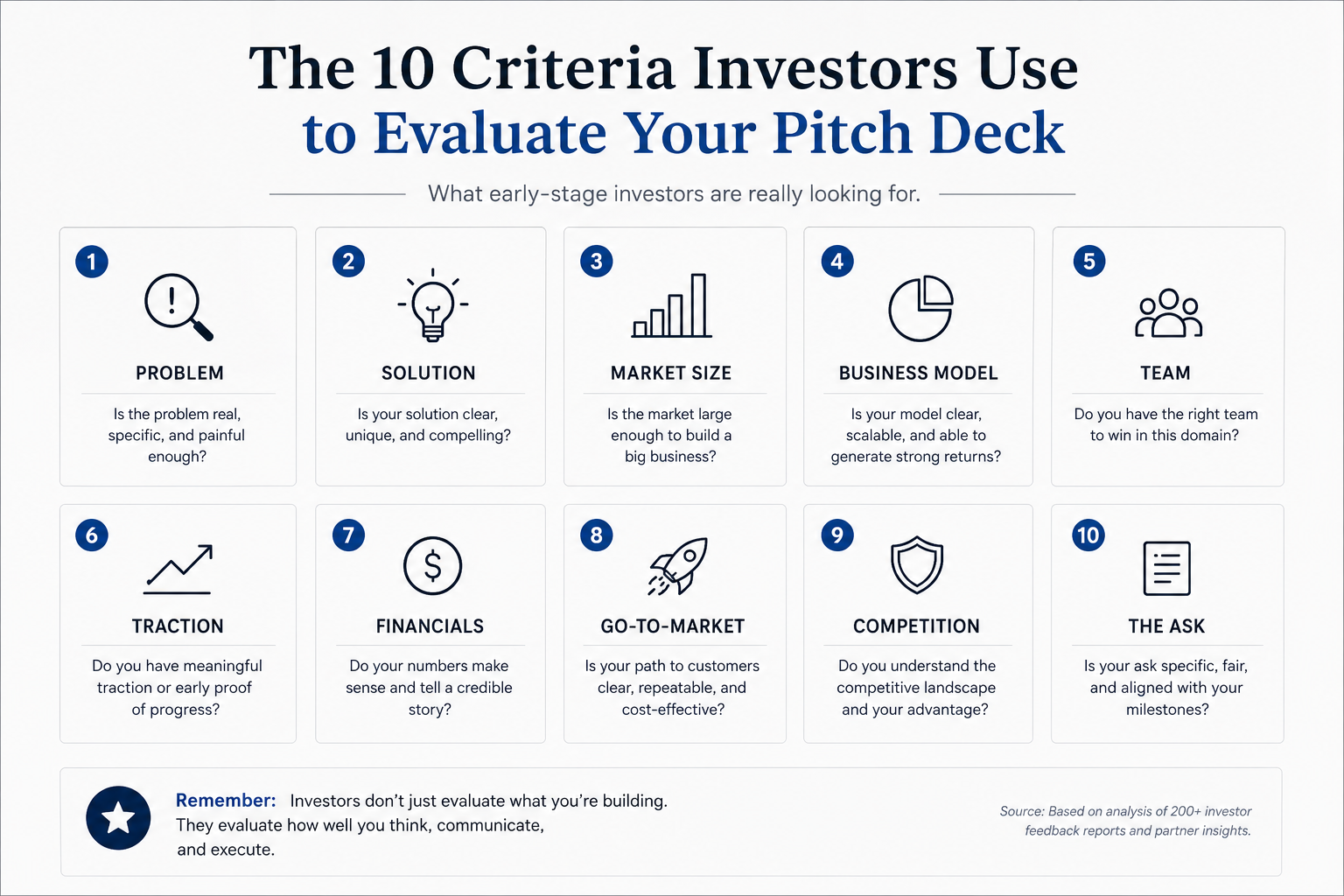
1. Problem Identification
Is this a real, urgent problem experienced by enough people?
A nice-to-have is not fundable. A hair-on-fire problem is. The investor is asking: Have you found a real customer pain point, or are you solving a problem that exists in theory but not in practice?
2. Solution Clarity
Does the solution actually solve the problem?
The investor should not have to make that connection themselves. The logical line from "problem" to "solution" should be so clear that it feels inevitable.
3. Market Size
Drop the $50B TAM bubble chart.
TAM (Total Addressable Market) is the total revenue opportunity if you captured 100% of the market. SAM (Serviceable Addressable Market) is the portion you can actually reach with your business model and geography. SOM (Serviceable Obtainable Market) is the realistic slice you can win in the near term.
Show your SOM — the precise slice you can actually capture in the next 18 months — with a clear go-to-market rationale underneath it. The investor is not asking how big the total market is. They are asking if you understand how to capture a meaningful piece of it.
4. Business Model
How does the company make money?
Is the path to healthy unit economics clear and logical? Can you articulate your pricing strategy and explain why customers will pay? A decks that discussed pricing strategy were 30% more likely to raise.
5. Team Strength
Already covered, but worth repeating: this is the criterion where investors spend the most time.
Domain expertise that is directly relevant to the problem you are solving is the most powerful signal. Investors are asking one core question: Does this team have an unfair advantage in winning this market?
6. Traction
Show month-over-month retention or engagement data, not just total user numbers.
A founder who understands their retention understands their business. Early revenue, pilot customers, pre-orders, or active usage patterns carry far more weight than theoretical projections.
7. Pitch Clarity
Can the investor follow the story from beginning to end without confusion?
Clarity is a proxy for how clearly the founder thinks. If the deck is confusing, the investor assumes the founder's thinking is confused.
8. Competitive Positioning
Not a magic quadrant where you win everything.
A specific explanation of why your approach wins against real alternatives for your specific customer. Show that you have thought about competition — not that you have none, but that you win anyway.
9. Founder Authenticity
Do they believe in what they are building?
Investors have seen thousands of founders. They can tell the difference between genuine conviction and trend-chasing. If you are building this because it is hot, they will feel it. If you are building this because you saw a problem and had to solve it, they will feel that too.
10. Growth Mindset
Is the founder coachable?
Early-stage investing is a ten-year relationship. They are buying the person, not just the idea. A founder who is defensive about feedback or unwilling to adapt is a higher risk than a founder who is genuinely curious about how to improve.
You don't have to guess how your deck stacks up against these 10 criteria. Startup Pitch Analyser evaluates your pitch across all ten — Problem, Solution, Market, Team, Traction, Financials, Clarity, Competitive Positioning, Authenticity, and Coachability — and shows you exactly where the gaps are before you face a real investor.