Why the Same Pitch Deck Gets Different Verdicts on Different Days
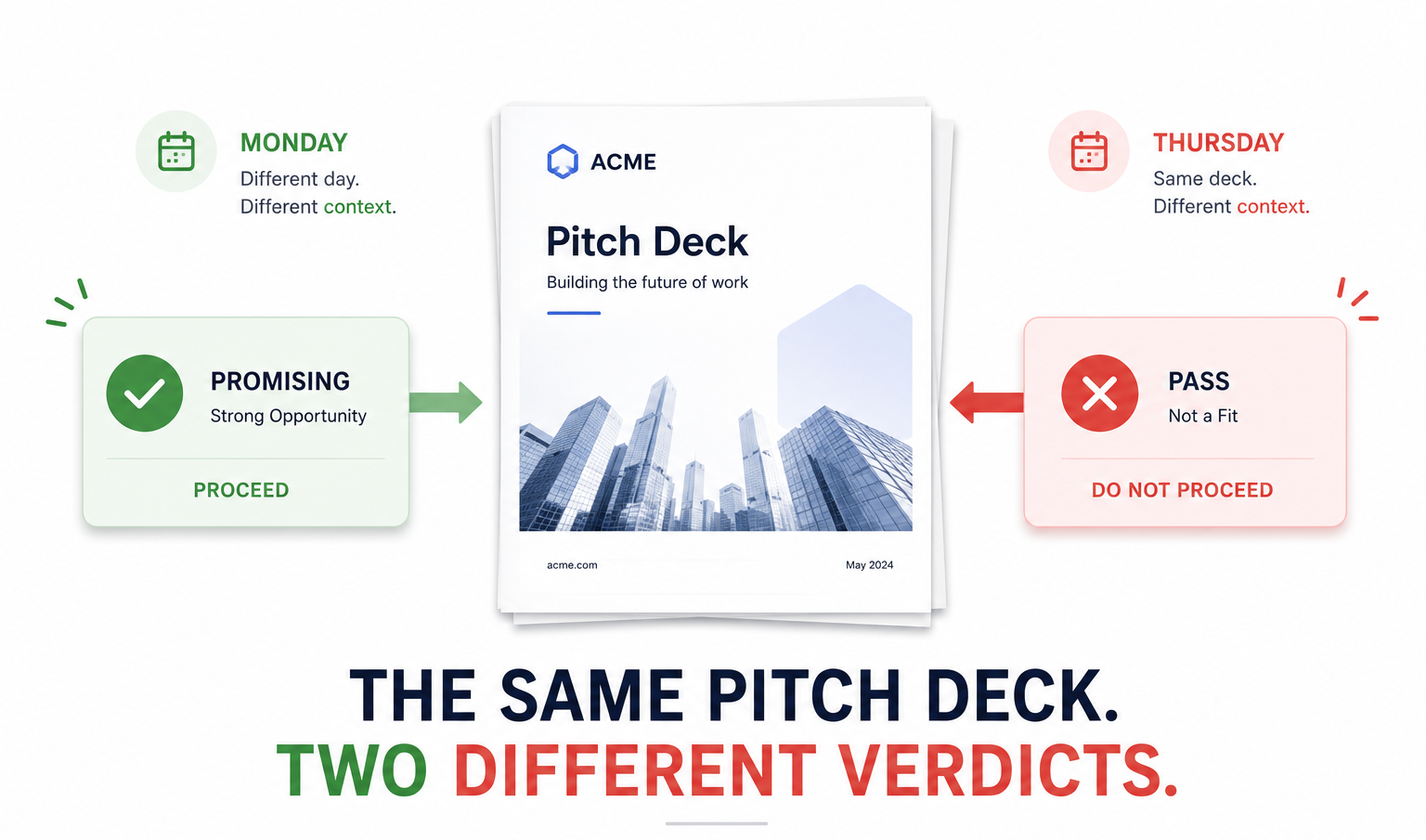
Two associates reviewed the same startup pitch deck on different days. One said yes. One said no. The business did not change. The context did.
A managing partner at a seed fund told me something recently that reframed how I think about startup evaluation at scale.
She had just finished reviewing her team's first-pass notes on the latest batch of inbound applications. What she found surprised her not because it was unusual, but because it was so clearly structural.
The same startup pitch deck had been through the first-pass evaluation process twice on two different days. The first time, it was flagged as highly promising. The second time, it was passed.
She understood exactly what had happened. Different days, different conditions, different contexts feeding into the same evaluation process. The outcome had nothing to do with the quality of the startup itself.
"The business did not change between Monday and Thursday," she said. "What changed was the conditions around the review. And that tells me the process needs a consistent structure."
That instinct to solve it structurally rather than blame the team is what separates the best-run funds from the rest.
Why Does the Same Pitch Deck Get Different Reads?
This is not a story about a poorly run fund. It is about a challenge that is built into how human evaluation works at volume.
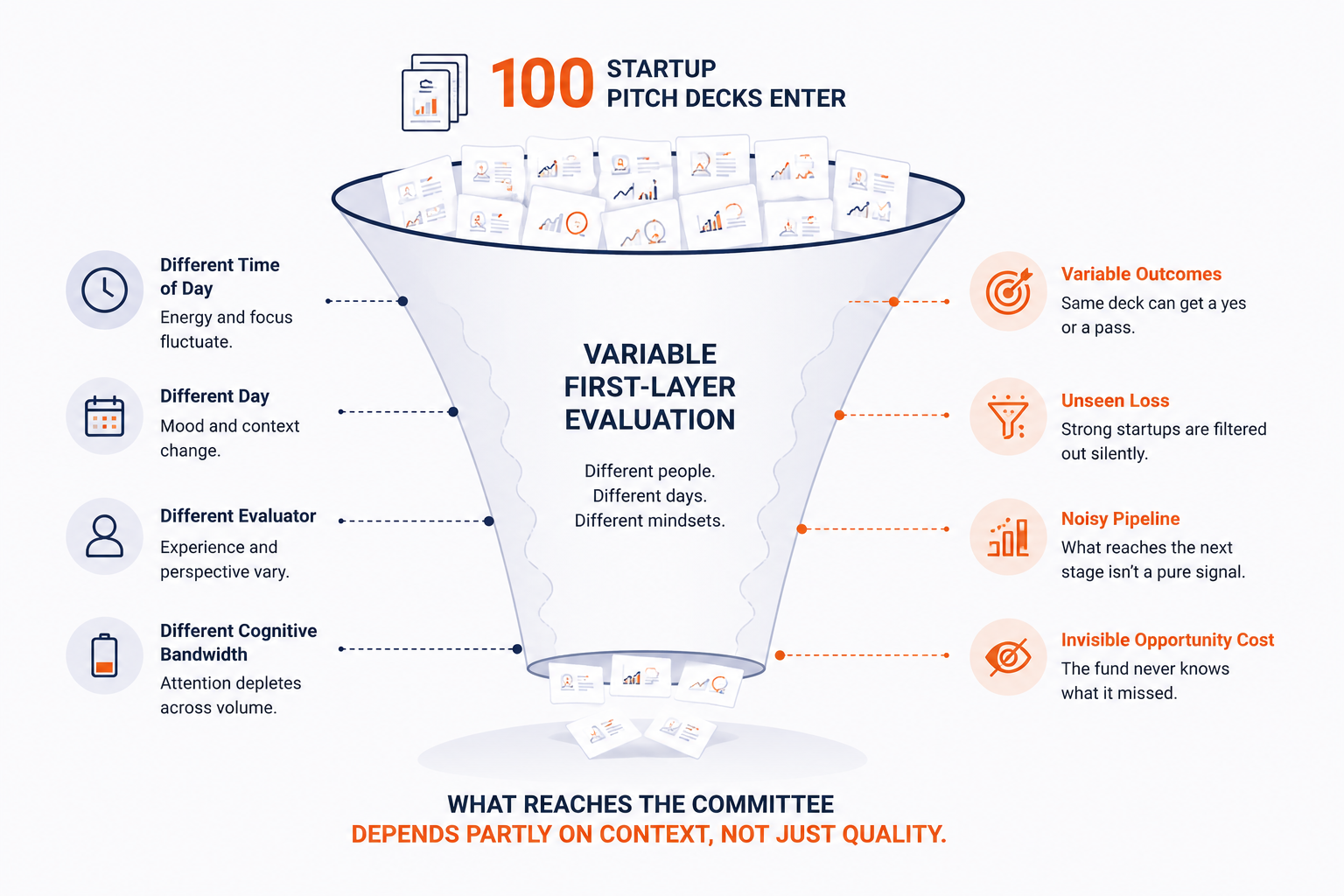
When first-pass evaluation happens under variable conditions at different times of day, different workloads, different energy levels feeding into the same review process the output is shaped by factors that have nothing to do with the startup being evaluated. A pitch deck reviewed at nine in the morning after a clear calendar gets a different quality of attention than the same deck reviewed at four in the afternoon after three back-to-back calls. A review that follows a strong portfolio update carries a different energy than one that follows a difficult LP conversation.
None of this is a flaw in anyone. It is how any evaluation process built on manual review works under volume. Cognitive bandwidth is a finite resource in any system that relies on it and it depletes across the day, across the week and across the volume of decisions flowing through the process. The quality of the tenth evaluation in a session is measurably different from the first not because anything changed in the process design, but because the resource it depends on was spent.
The result at the fund level is that whether a startup progresses past the first filter depends partly on variables that have nothing to do with the business itself: which day the review happened, what else was in the queue, how much capacity the process had left. For individual startups, this is a question of fairness. For funds, it is a question of pipeline quality.
What Happens When the First Layer Is Inconsistent?
The downstream effects of an inconsistent first layer are easy to miss because they are invisible. You do not see the deals that were passed on incorrectly, they simply disappear from the pipeline.
A startup that would have been flagged as strong on Monday morning gets a pass on Thursday afternoon. The fund never knows what it missed. The founder never gets a callback. The deal moves on to another investor who happened to review it under better conditions.
Over time, this adds up. The pipeline that reaches the investment committee is not a clean representation of the quality that entered the top of the funnel. It is a composite shaped by variable conditions — which day the review happened, what else was in the queue, and how much capacity the process had left. The committee makes decisions based on what surfaced, not knowing that the surfacing process itself introduced noise.
How Do the Best Funds Build Consistency Into the First Layer?
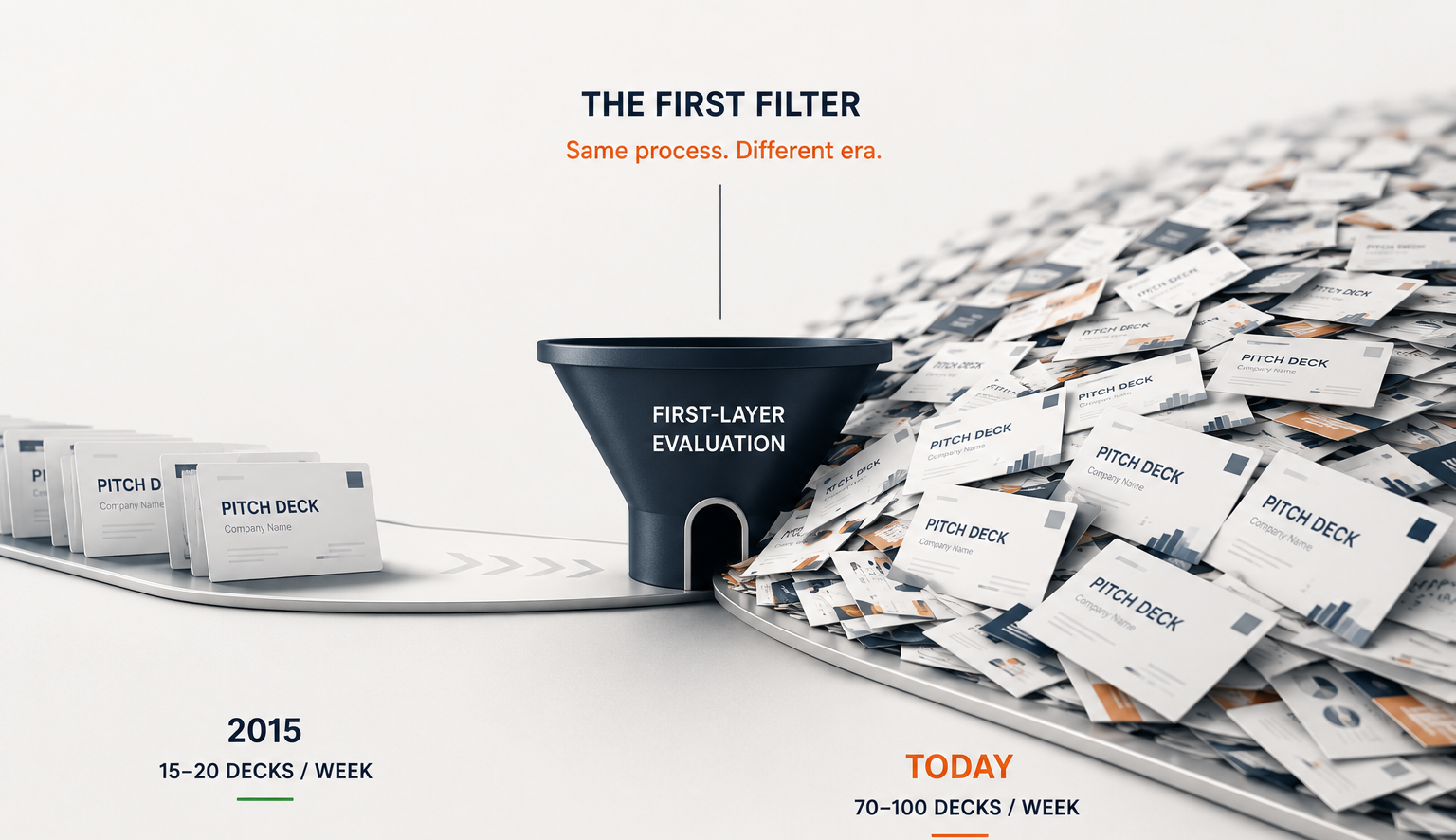
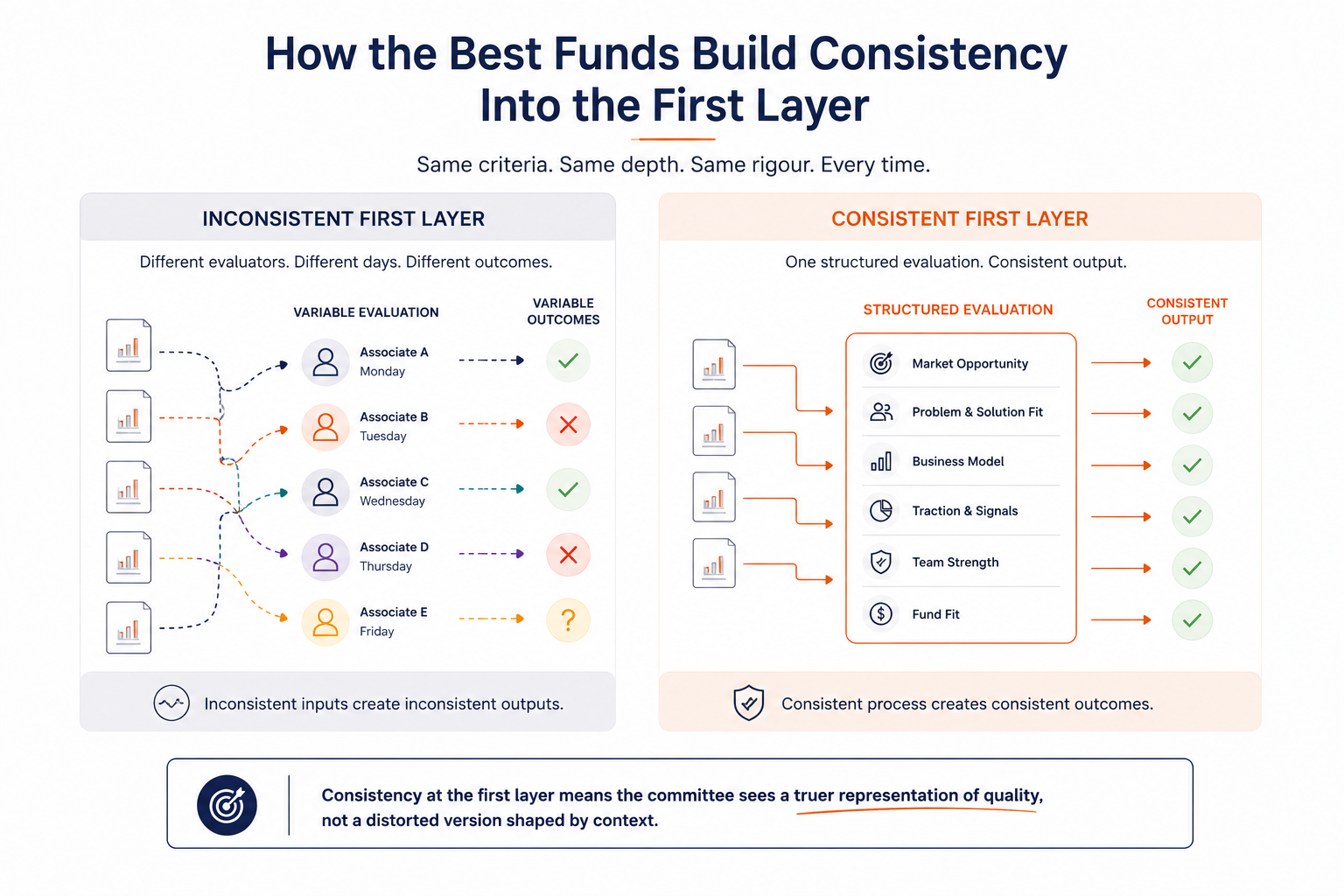
The insight the smartest startup investors share is straightforward: the first layer of evaluation needs to be consistent, structured, and independent of the conditions under which any individual review happens to occur.
This does not mean removing human judgment from the process. It means applying human judgment at the right stage after the first layer has done its job of producing a uniform, structured starting point.
When every startup pitch deck in the pipeline goes through the same structured evaluation, same criteria, same depth, same rigour, regardless of when it was submitted or what conditions the manual process would have been operating under the output changes fundamentally. What reaches the investment committee is a set of deals that have all been measured against the same bar.
The partner sitting down with a startup founder after a consistent first-layer evaluation is not starting from zero. They are starting with structured context knowing what was said in the evaluation session, where the claims held up, where the gaps appeared and which questions matter most. The first human conversation is sharper because the inputs are better.
Consistency at the first layer also builds something that compounds over time. When every deal is evaluated against the same framework, the fund accumulates a coherent dataset of structured evaluations which sectors are producing the strongest pitch decks, where the thesis is generating traction, what patterns distinguish the deals that progress from the ones that do not. That institutional intelligence informs thesis refinement, LP reporting and portfolio construction in ways that inconsistent first-pass notes never could.
The Consistency Advantage Compounds
The funds that build consistency into the first layer are not just processing more deals. They are building a structural advantage in pipeline quality that compounds over every fund cycle.
When the first layer is consistent, the strong deal from an unfamiliar market gets the same evaluation as the warm-intro deal from a familiar geography. The startup founder who submitted on Friday evening gets the same quality of review as the one who submitted Monday morning. The startup pitch deck that arrives during a busy week gets the same depth as the one that arrives during a quiet one.
That consistency is what turns a pipeline from a collection of variable impressions into a reliable signal about where the best deals actually are. The decisions the fund makes improve — not because anything changed in the team's capability, but because the inputs feeding into their judgment became better.
The managing partner I spoke with saw this clearly. The quality of the business did not change between Monday and Thursday. What needed to change was the system so the evaluation matched the quality of the team's judgment, at any volume, on any day.
This is the problem we set out to solve when we built Smart AI Investor, a structured first layer that evaluates every deal with the same depth and rigour, so the investment team's expertise is applied where it matters most. See the platform at venturehub360.com/smart-ai-investor
Smart AI Investor conducts structured AI-led pitch sessions with every founder in your pipeline, researches each startup independently, and delivers IC-ready evaluation reports — complete with session recordings, smart transcripts, AI insight memos, and standardised scoring — so your team evaluates more deals with the same headcount.